Most plumbing advice assumes a city water main at the street. In Hidden Valley, that assumption fails, and it changes what goes wrong, who fixes it and what it costs. This page explains the differences for homeowners in this corner of the Conejo Valley area and closes with using the quote form.
How does well water change a home's plumbing?
Residents of Hidden Valley rely on wells for their water, and the Hidden Valley Municipal Water District does not provide drinking water. That means your plumbing starts at your own well, pump and tank, not at a utility meter. When pressure drops or water stops, the cause may be the pump, the pressure tank or the well itself, and a standard city-water fix will not solve it.
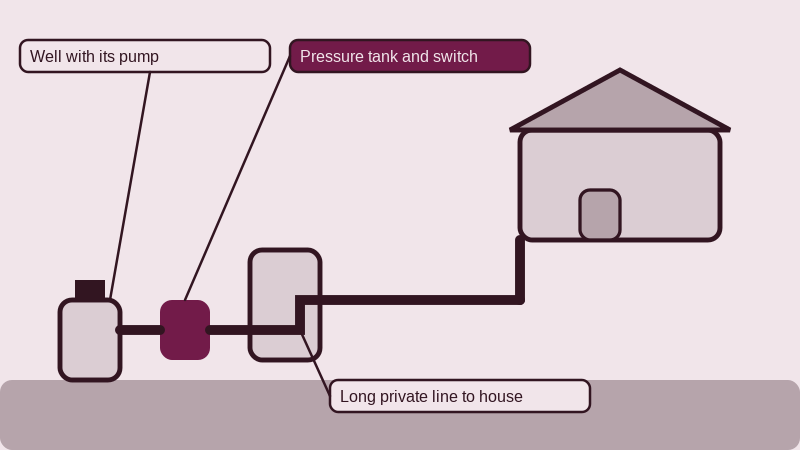
A well system has parts a city home lacks: a pump, a pressure tank and switch, often a filter or treatment set-up, and a long line to the house. No source on well depths, water quality or treatment in Hidden Valley turned up, so we make no claim on them. Owners of a well should get the water tested by a laboratory, and a plumber or well contractor can inspect the pump equipment.
Typical signs include cycling pumps, sputtering taps and a sudden fall in pressure. Our low water pressure page separates household causes from supply causes.
What kind of property is Hidden Valley?
Hidden Valley is a valley in the Santa Monica Mountains in southeastern Ventura County, bordered by Lake Sherwood to the east, Newbury Park to the west and north, and the Santa Monica Mountains National Recreation Area to the south. It is an unincorporated equestrian ranch community, and homes are single-family on parcels of 20 acres or more.
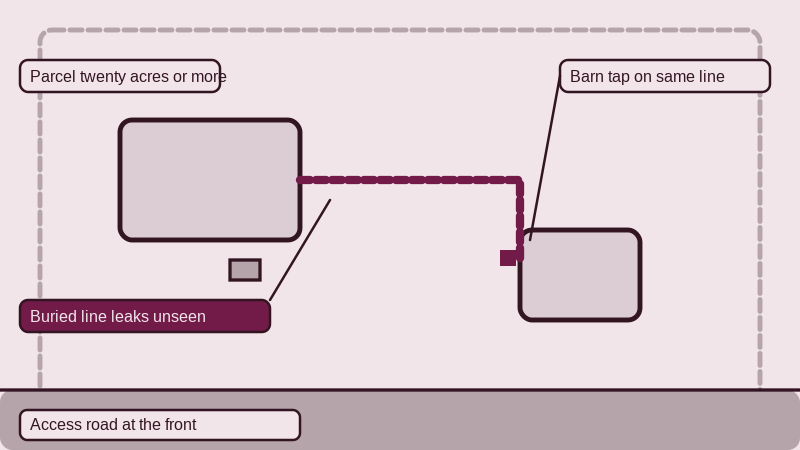
Large parcels mean a long run from the well or the road to the house, outbuildings that need water, and sometimes guest houses, barns or horse facilities with their own taps and troughs. Each extra building adds pipe, valves and a place for a leak. A buried line that leaks in a pasture can run for weeks unnoticed, so a quiet rise in power use from a pump that never stops is a clue. The high water bill page and the leak detection cost guide explain how to look for hidden loss.
Pipe age varies widely, since the valley is a place of individual estates and not of one tract. Before planning a repipe, have a plumber work out which pipe you actually have.
What do well and ranch plumbing jobs cost?
No made-up Hidden Valley rate appears here. Prices depend on pipe length, trenching, access and equipment, and a visit to look at the setup is often needed before a quote is realistic. For the general ranges plumbers charge, see the plumber cost guide.
Several things raise the cost of work here that rarely apply in town. Long driveways and rough roads add travel and time. Trenching through rock or around mature oaks is slow. Replacing a line that runs hundreds of feet costs far more than replacing a short city lateral. Water treatment, a softener or a filter for well water is a separate job; the water softener cost page gives a sourced starting point, though well water can differ from city water. Have the pump, tank, pipe and labor itemized on separate lines.
Which rules and offices apply in Hidden Valley?
Hidden Valley is unincorporated, so building permits generally go through the Ventura County Resource Management Agency, 800 S Victoria Ave, Ventura, CA 93009, whose main line is on the agency's page. The counter is open 8am to 4pm Monday, Tuesday, Wednesday and Friday and 9am to 4pm Thursday, according to the agency's page. Confirm the hours before you go.
Wells themselves are a separate regulatory matter, and we did not verify the county's well rules. Ask the county before drilling, deepening or replacing a well. Replacing a water heater, gas piping or a main service line is permit-level work that a contractor should handle.
If you smell gas, leave the property first. Outside, contact SoCalGas on 1-800-427-2200, or use 911 when anyone is at risk. We could not confirm whether every Hidden Valley street has natural gas service, so check your own property before assuming it.
Rural parcels also face fire risk. If you evacuated or a fire came near, shut off the pump power and check for heat-damaged lines before restarting.
What is the process for booking a plumber in Hidden Valley?
Start on the quote form and say that you use well water. Describe the symptoms, how to get onto the parcel and whether there is a gate. We send the details on to local plumbing businesses that pay a fee, and the plumber who accepts visits with a written quote. Steps are listed on the how it works page. Staff read the form on weekdays from 9am to 5pm.
Gather a few facts first: where the pump and tank sit, when the pump was last serviced, whether it cycles, and any recent water test. In an emergency, switch the pump off at its breaker, close the house main and read the burst pipe guide.
Common questions
How much is a plumber in Hidden Valley?
Pipe length, access and equipment set the price, so we state no fixed Hidden Valley figure. Work on wells and long private lines usually needs a site visit before a quote is firm. The plumber cost guide has sourced general ranges, and you should get the quote in writing.
Does Hidden Valley have city water?
No. According to the community's Wikipedia page, residents rely on wells, and the Hidden Valley Municipal Water District does not provide drinking water. Your plumbing therefore starts at your own well, pump and tank, and problems with pressure may trace back to that equipment rather than the house.
Do local rules cover plumbing in Hidden Valley?
No city council exists here, since the valley is unincorporated. Building permits generally go through the Ventura County Resource Management Agency, and a contractor normally files them. Rules for the well itself are separate, so check with the county ahead of any drilling or major well work.
How should I respond if my well pump never stops running?
Turn the pump off at its breaker so it does not burn out, then close the house main to learn whether a leak is the cause. A pump that cycles constantly can point to a leak, a failing pressure tank or a worn pump. Have a plumber or well contractor inspect it.