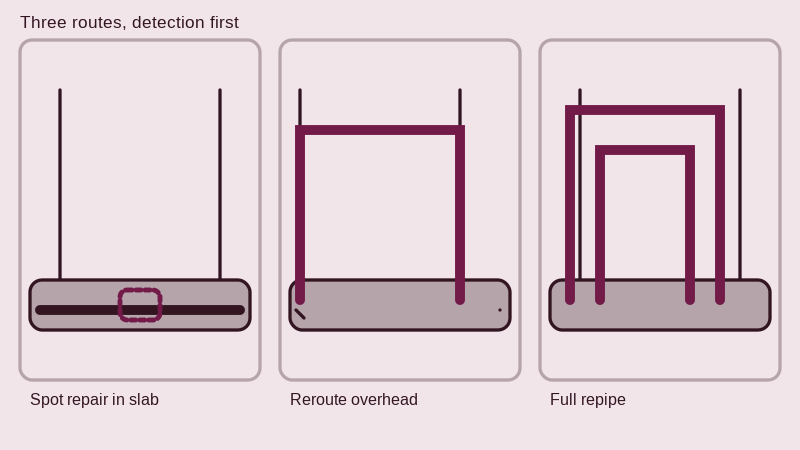
Slab leaks happen when a water line beneath the concrete floor starts to leak. The options are to repair the single failed section, bypass that line by running it overhead through the attic or walls, or repipe the entire house. A single spot repair suits one failed line in otherwise sound plumbing. Repeated leaks usually point to a repipe. The right answer comes from leak detection first, then a written quote. Start on our home page or send the quote form.
The visit is arranged for you: a local plumber arrives at your house, finds the leak, lays out the options and gives a quote before any work. Below is how each fix works, what drives the price, and which signs favor one route. The question comes up often because Thousand Oaks and Newbury Park contain plenty of slab on grade houses built over four decades, from the 1960s to the late 1990s.
How does slab leak repair differ from a repipe?
Slab leak work follows three routes. Cutting into the concrete above the leak and replacing the damaged piece is the spot repair. With a reroute, the leaking underfloor line is abandoned and a new one runs through the walls or attic. A repipe replaces every supply line in the home. Each starts with detection, so floors are never opened on a guess.
Spot repair. Listening equipment or a pressure test pinpoints the leak, then the plumber cuts the floor, removes the faulty section and patches the slab. It is the quickest route and the cheapest on the day, yet the rest of the line stays as it was. Where the pipe elsewhere has the same age and material, another leak may follow soon.
Reroute. One line, often the hot line or a single bathroom feed, is capped at both ends under the slab and replaced by a new line overhead. The floor stays intact, though some wall and ceiling openings need repair.
Repipe. Every supply line is renewed, usually in PEX or copper. It disrupts the house more, but it ends the cycle of repeat leaks. On which material to pick, see PEX versus copper; for the whole-house process, read how to repipe a house.
Should you consider epoxy lining for a slab leak?
With epoxy lining, a resin is applied to the interior surface of existing pipes, sealing pinholes and small leaks without opening the floor. It can suit a line that is intact but thin from corrosion. It does not suit pipes with a split, a bad joint or severe damage, and whether it is allowed in your home depends on local rules and the plumber's assessment.
Ask the plumber to explain why lining suits your pipe and to show what a failed part would mean for warranty. Lining reduces the inside diameter slightly, so flow and pressure can change, and a repipe is hard to do later around a lined section. Treat lining as a repair for the right pipe, not as a shortcut. If a plumber proposes it, ask for the product name and the written terms before you agree.
Not every plumber offers epoxy lining, and it is not suited to every pipe. For that reason, it pays to request a quote for a second route too, so you can compare.
How should a house on a slab be repiped?
On a slab house, a repipe generally means new lines through the attic and walls down to each fixture, with the old underfloor lines capped. The concrete is not broken up. PEX is the usual pick since it flexes around corners and requires fewer joints. Ask the quote to include a plan for wall repair.
Repiping in a slab house is cleaner than people expect because the plumber does not dig. The main work is wall and ceiling openings, followed by drywall patching, which is often separate from the plumbing price. Ask who handles patching and painting, and write it down.
Homes with galvanized steel or older copper may have pressure and discoloration problems alongside leaks. If your house has had two or more leaks, a repipe quote deserves a look. Hillside homes with long runs and lots of bends can cost more than flat lots, simply because of the extra work to reach each fixture. For costs, read what repiping a house costs and slab leak repair cost.
What affects the price of fixing a slab leak or repiping?
Cost tracks the amount of floor, wall and finish work involved. Fixing a spot under a tiled hallway costs more than under bare concrete, since tile must be lifted and matched. A reroute grows with fixture count and run length, while a repipe scales with home size and the number of bathrooms.
The factors that move the number:
- Where the leak sits. Under a kitchen island or tile is slower than in a garage.
- Floor finish. Tile, wood and carpet each need their own repair.
- Number of leaks. One leak or several changes the choice of route.
- Pipe material and age. Pinholes in older copper often signal more to come.
- Access. Attic height, hillside layout, a second story.
- Permit and inspection. Repipes generally need one. Which of the City of Thousand Oaks Building and Safety or the Ventura County Resource Management Agency applies depends on the address, and either can confirm the rules.
- Detection method. A listening and pressure test is usually part of the first visit.
We do not publish a dollar figure here because we have not checked a source that lists local slab leak prices, and the price depends on those variables. Whichever plumber takes the job gives a written quote before starting.
Which signs point to a slab leak that needs fixing?
Watch for warm patches on the floor, the sound of running water when everything is off, damp carpet or baseboards, and a water bill rising for no other reason. A meter that keeps turning while every tap is closed means a leak somewhere in the supply, though not necessarily under the slab.
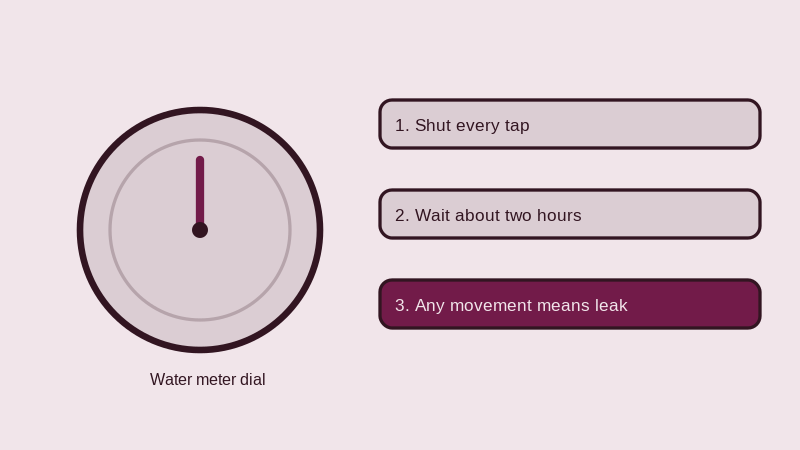
Testing the meter takes three steps: shut off every water use, write down the reading, and check it again after about two hours without using anything. According to the EPA, a changed figure means a leak is likely. Slab leaks add other clues:
- A warm patch on the floor, often above the hot water line.
- Low hot water pressure, or hot water that takes much longer to arrive.
- A musty smell, mold or cracked grout.
- Water pooling at the foundation outside.
If you smell gas, leave the house immediately and contact SoCalGas at 1-800-427-2200 once you are outside; 911 is for anyone in danger. Gas lines can also pass through a slab, so a hissing sound needs a proper diagnosis. The guide to a high water bill with no visible leak covers bills that climb without any visible leak.
When should you shut off the water and request a quote?
The moment you suspect a leak under the floor, shut the main valve if it is within reach, then complete the quote form. A slab leak may go unseen for weeks while it soaks flooring and walls, so asking early limits damage. Photograph any wet spots and the meter reading.
Learn where the main shutoff is before you need it. It is usually found at the front of the house beside the hose bib, or near the water heater. On a well, as in parts of Hidden Valley, it may be found at the pressure tank. For burst pipe emergencies, read the burst pipe emergency guide. Never stand beneath a wet floor or a sagging ceiling.
You can submit the quote form at any hour, and we go through requests on weekdays between 9am and 5pm. Each one is passed to nearby plumbing businesses, and those businesses pay us a fee. If water is flooding the house right now, close the main valve first.
Common questions
How long does fixing a slab leak or repiping take?
A spot repair or reroute takes about a day or two, with floor patching on top. A whole-house repipe usually lasts several days, and drywall repair follows. Ask the plumber to put a timeline in the quote; a permit inspection can add further time. Also confirm what the price covers and who fixes the walls.
What should a slab leak quote spell out before I accept?
Ask how the leak will be found, which route is recommended and why, what happens to the old lines, and who patches walls or floors. Confirm the permit is covered, and ask how the price changes should a second leak show up. Get each answer written into the quote ahead of the start of work.
Does someone need to be home during the work?
Yes, an adult should attend the first visit and open every room, because furniture gets moved and walls may be opened. During a repipe, stay reachable and prepare for water shutoffs and noise. Confirm with the plumber the hours when the water will be off.
Does a slab leak always mean the house needs a repipe?
No. One leak in an otherwise healthy line can be spot repaired. Repeated pinholes, leaks in several places, or older pipe in poor condition make a repipe more attractive. A plumber can show you the pipe material and the leak, so you can compare the quotes.