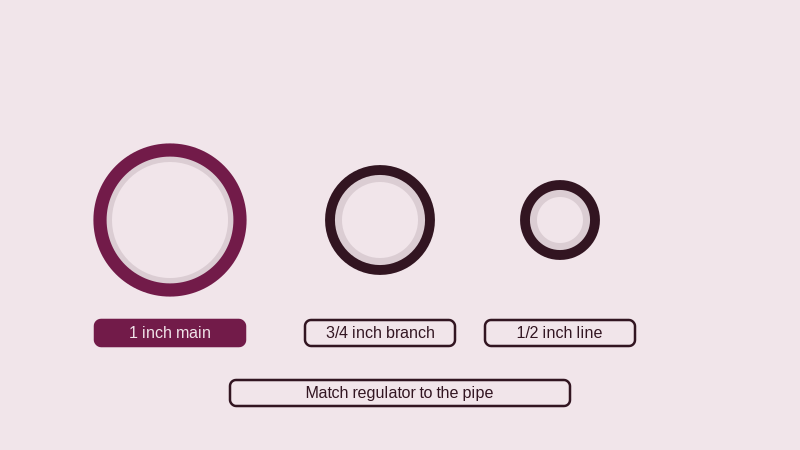
This type of regulator fits a service line with one inch connections. It is chosen when the main is that size, or when a large house, an irrigation system or several bathrooms need high flow through the regulator. Buying the wrong size is the commonest mistake. Measure the pipe first, then read the label on the old valve. Our low water pressure page supplies the broader context, and the price request page is where you can ask a plumber to confirm.
When is a 1 inch regulator the right size?
It is right when your main line and the old regulator are one inch, or when the house has high simultaneous demand, such as several bathrooms, a large irrigation draw or a big household. Matching the pipe avoids needless reducers. The regulator's connection size should follow the pipe, with capacity checked against the demand.
Measure it properly. Pipe is sold by nominal size, and outside diameters differ between materials. Copper tube labeled one inch has a different outside diameter from a one inch threaded steel nipple. Read the stamp on the old regulator body, which usually shows the thread or union size, and photograph the pipe on each side.
If the old unit is smaller than the pipe, reducers may appear on either side. That can suggest the house was fitted with a regulator that chokes flow. A plumber can check the flow with a test. Reasons to go larger than three-quarter inch are rare in a modest house.
How does a 1 inch regulator differ from a smaller one?
A one inch unit passes more water at a given pressure drop, which keeps flow steady when many fixtures run. A three-quarter inch unit is fine for many homes and costs less. A smaller regulator can choke a big household. Size by demand and by the pipe, not by guess.
The comparison in plain terms:
- Capacity: one inch carries more flow with less drop.
- Price: it costs more, and so do the unions and fittings.
- Fit: it needs one inch pipe or adapters.
- Use case: large homes, long runs, irrigation off the same main.
Other sizes appear on our pages for three-quarter inch regulators, half inch regulators and quarter inch types. The whole-house regulators page describes a whole-house unit.
What features should I look for?
Look for a lead-free body rated for drinking water, a gauge port, an adjusting screw with a lock nut, union connections that allow a future swap, a replaceable cartridge or a repair kit, and a stated pressure range. A built-in bypass for thermal expansion is a feature some models offer. Compare the manufacturer's flow chart with your demand.
Questions to ask of any model:
- Is the body marked for potable water use?
- What inlet pressure does it handle and what outlet range does it set?
- Does it have unions, or must the plumber cut pipe?
- Is there a gauge port for a test gauge?
- Can the cartridge be replaced without removing the body?
Do not pick on price alone. A cheap regulator that fails in a few years costs a second visit. For more on choosing, see our page about picking a home regulator.
What pipe material affects the fit?
Copper, PEX, galvanized steel and CPVC each connect differently. Copper takes soldered or push-fit unions, PEX takes crimp or clamp adapters, and galvanized steel takes threaded fittings, though old galvanized pipe is often too corroded to disturb. Tell the plumber the material when you ask, so the right adapters arrive.
Many homes in Thousand Oaks and Newbury Park have copper mains, and some older ones may have galvanized sections. Newer homes in Dos Vientos and North Ranch may have PEX inside and copper at the main. If you spot old galvanized pipe at the main, our guide to replacing galvanized pipe is worth reading before you cut into it.
How is the pressure set after installation?
Attach a test gauge to a hose bib or the gauge port, shut every tap, and turn the screw until the reading falls in the range the plumber selects for the house. Tighten the lock nut. Check again after a day and after the water heater has cycled. A reading that climbs overnight shows the regulator is failing to hold.
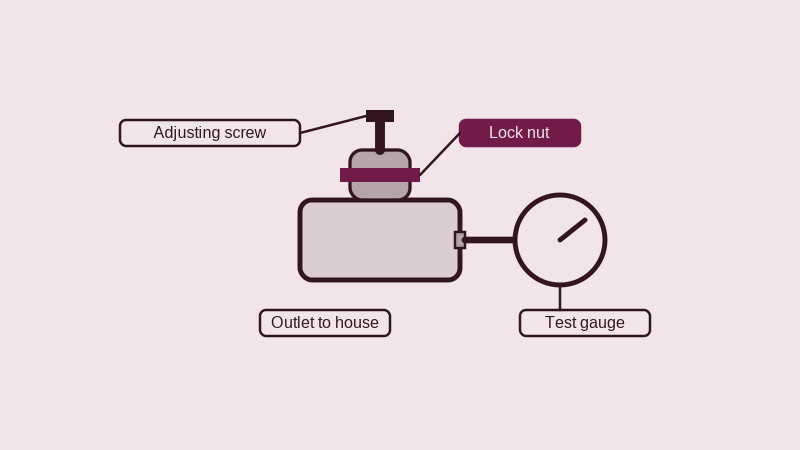
Never guess the setting. Fixtures, appliances and the heater all have working limits, stated on the manufacturer's label. Afterwards, also check the heater's relief valve and expansion tank, since a regulator can create a closed system. The full swap is covered on our regulator replacement page.
Can I do the swap myself?
A plumber is the better choice if the main shutoff is stiff, the pipe is old, the regulator is soldered in, or the right size is uncertain. An owner who is confident, has good access, a working shutoff and union connections can handle a straight swap. A mistake risks a flooded garage and no water for the whole house.
If you bring someone in, ask for a license number, which California generally requires above a set job size, and check it with the state board. Permit rules for a straight swap vary, so ask City of Thousand Oaks Building and Safety for city addresses, or the Ventura County Resource Management Agency for unincorporated parts of the valley. Estate lots with private wells around Hidden Valley use a different pressure arrangement, which a plumber should assess separately.
Common questions
Is it okay to fit a one inch regulator on a three-quarter inch line?
With adapters it can be done, but it rarely helps, because the pipe still limits flow. A bigger valve does not make a smaller pipe carry more, and it adds fittings and cost. Better to size the regulator to fit the pipe, unless the plumber has a reason such as a planned upsizing of the line.
Does a bigger regulator give more pressure?
No. A regulator reduces pressure, it does not create it. A larger size passes more flow at a given setting, and that can make the pressure feel steadier when many fixtures run. Low pressure from the street is a supply question, not a regulator question, and a gauge reading from a plumber will show it.
How can I tell a regulator is wearing out?
Signs include noise, leaking fixtures, a weeping heater relief valve, a gauge that creeps up overnight, or weak flow. A gauge reading says the most. If it sits far from the plumber's setting, or drifts, the regulator is worn. Our page on low pressure goes through other causes.
Does every house need a regulator?
Many houses lack one, and some do not need it when supply pressure is already moderate. A quick gauge test settles it. Many hillside homes see high pressure and benefit. With a stable reading inside safe limits, the plumber may tell you to leave things alone.
How do I ask for a plumber?
Visit the price request page, state your pipe size and material if known, and attach a photo of the old regulator and its label. A local plumber then comes out with a written quote. Begin at Conejo Plumbing Pros for other topics.