Repiping means replacing the supply lines that bring water from where it enters your house to every faucet, toilet, shower and appliance. It is large but well-defined work, and knowing the order helps you weigh a quote. This guide sits in our repiping and pipe replacement section and is written for owners of older homes around Thousand Oaks and Newbury Park, where the original pipe is now decades old.
Rarely will you do this yourself. A whole-house repipe is contractor work, so what is worth learning is the plumber's job, your preparation, and the choices that belong to you.
What are the steps in repiping a house?
The sequence is fixed. The plumber closes the water at the main, drains the system, opens access through walls and ceilings, runs new supply lines to each fixture, connects them, pressure tests the entire system, restores water, and then patches the openings. Drywall repair and paint are often separate trades.
In more detail: day one is planning the route and protecting floors. The plumber then cuts small access holes, pulls out or abandons the old lines, and runs new pipe from a central point to each room. Each fixture is reconnected, and a pressure test looks for leaks before walls are closed. Once water returns, run every tap to clear debris. Expect a few days without normal water use, and have the plumber include a day-by-day outline in the quote.
What drives the price of a PEX repipe?
Your house shapes the price of a PEX repipe far more than the pipe itself. The biggest factors are the count of bathrooms, fixtures and stories, how simple the walls are to open, the pipe you choose, and the amount of patching included. We give no single figure, since the plumber supplies a written quote after seeing the house.
Check what the quote covers: the permit, pipe and fittings, water heater connections, shutoff valves, the pressure test, and wall repair. Weigh quotes item by item, not only by the bottom total. Our full repipe cost guide explains the line items and what raises a price. Send the quote form and we hand the request to a local plumber, who prices it.
What is the process for a PEX repipe?
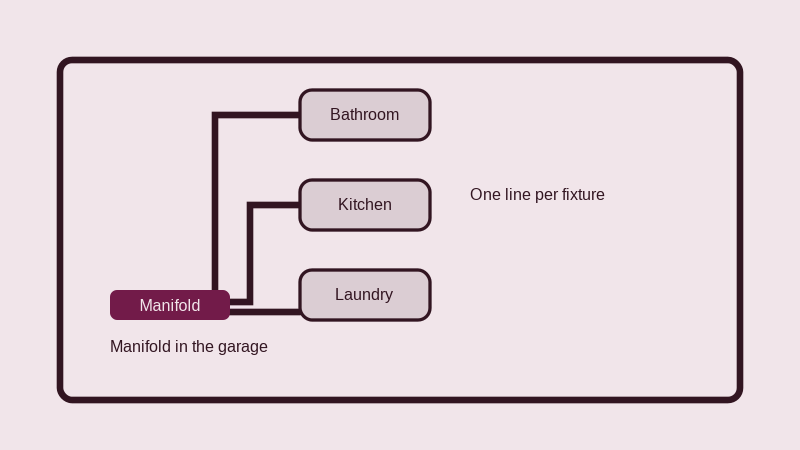
A PEX repipe typically uses a home-run layout. Lines leave a central manifold and run to each fixture with no joins between, so a leak at one fixture does not take down the rest. The plumber cuts PEX to length, pulls it through walls and attic space, and makes connections with crimp or expansion fittings.
Often found in a garage, closet or utility space, the manifold lets you shut off one fixture at a time, which is handy when a faucet needs work. Benefits include fewer joints inside walls and more forgiving behavior in a cold snap. A plumber will explain where the PEX must not be exposed to sunlight, since the material should be kept covered, and will size the lines to your fixtures and flow. Appliances such as the water heater, washing machine, ice maker and dishwasher are all reconnected as part of the work.
What does repiping involve for a house on a concrete slab?
For a slab home, the plumber normally leaves the old lines beneath the concrete in place, caps them, and routes the new supply lines through the attic or walls instead. That avoids breaking up the slab. The new lines drop down inside wall cavities to each fixture, so you gain new pipe without concrete work.
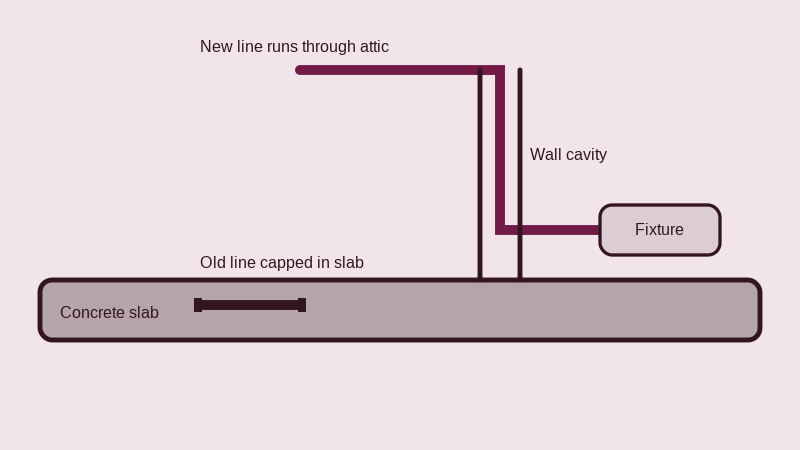
This reroute is common for houses built on a slab, which includes many tract homes in the area. The trade-off is more wall and ceiling openings than a crawl space house might need, and the old slab lines go unused. With a leak under the floor and a choice to make between a spot repair and full replacement, slab leak: patch it or repipe sets the two against each other. Where a drain line sits under the slab, that is a separate job from supply lines.
Which is better for a repipe, PEX or copper?
Either material will do, and the choice rests on budget, access and preference. PEX is flexible plastic tubing that passes through walls with fewer joints and needs fewer holes. Copper is a rigid metal with a long track record, suited to exposed runs and people who prefer metal. Neither is wrong, so have the plumber justify the recommendation for your house.
Think about these points: PEX bends around corners and goes in faster, which can reduce wall openings. Copper is joined by soldering, which adds heat and time in tight spaces. Water quality matters for both, so ask the plumber how the pipe you choose copes with scale and with what your supplier sends to your street. Copper or PEX when repiping in Thousand Oaks sets durability, noise and fittings side by side.
How should you prepare before the plumber turns up?
Clear the areas where walls will be opened, move furniture and belongings away from bathrooms and the kitchen, and locate your main shutoff. Mention pets, children, and anyone working from home to the plumber. Have your water heater information ready so the connections are priced properly.
Photograph each room before work starts so condition is clear later. Ask where you can get water during the shutdown, how long the system will be off each day, and whether the plumber leaves temporary supply. Agree who handles drywall repair and painting, since that is often outside the plumber's quote. Keep your insurance paperwork handy, in case an old leak has already caused damage.
When is repiping a better choice than repairing?
Consider a repipe when leaks keep recurring, water runs brown or metallic, pressure has dropped across the whole house, or the pipe type has a poor record. Galvanized steel and some older plastics are common culprits. One leak in good copper is a repair; repeated pinholes in several places point to a repipe.
Watch for the signs: ceiling stains, damp patches, a rising water bill, and weak pressure at many fixtures simultaneously. Repipe timing: how often it is needed gives the age ranges for each pipe material. Consider the work in terms of what the upgrade gives you: steadier pressure, fewer leaks and cleaner water. Before approving a repipe, ask the City of Thousand Oaks Building and Safety office whether a permit is required for your job.
Common questions
How many days does a whole-house repipe take?
An average single-story house needs a few days of work, while bigger or two-story homes need longer. Slab homes and houses with awkward access can go slower. The plumber supplies a schedule in the quote, including the hours your water is off each day. Drywall patching and paint usually add time afterward.
What should I ask before a contractor repipes my house?
Get the quote in writing, listing pipe type, permit, patching and cleanup. Ask how many days the water will be off, who fixes the walls, and how hidden damage would be handled. Find out how the plumber will protect your floors, and confirm who is named on the work order before you sign.
Should someone stay home during a repipe?
Yes. An adult needs to be home at the start to show access and approve the plan, and reachable throughout the job for questions and routing decisions. You do not need to hover, but the plumber needs entry every day. If you must be away, name a trusted adult and tell us when you send the request.
Can a slab foundation house be repiped without breaking the floor?
Usually the slab is left alone. The old lines are capped, and new lines come through the attic and drop within walls to every fixture. This avoids concrete cutting, though it does mean more wall openings. The plumber should show you the planned routes before work begins.
Can I do a whole house repipe myself?
It is not a sensible do-it-yourself job. A repipe involves permits, pressure testing and dozens of connections hidden in walls, where one weak joint causes serious water damage. Small tasks such as replacing a shutoff valve can be handled by confident owners, but the whole-house work is best left to a contractor.