
A leaking plastic pipe is usually stoppable in minutes, even if the lasting repair takes longer. Whether you live in a Thousand Oaks tract house or a Newbury Park ranch home, you begin the same way, and that opening step protects the ceiling underneath. Everything here sits under the wider Conejo Plumbing Pros home page for plumbing help in the Conejo Valley. Below you will find the order of steps, what changes outdoors, what a dripping tap needs, and where a patch stops being sensible.
How do I stop a plastic water pipe from leaking right now?
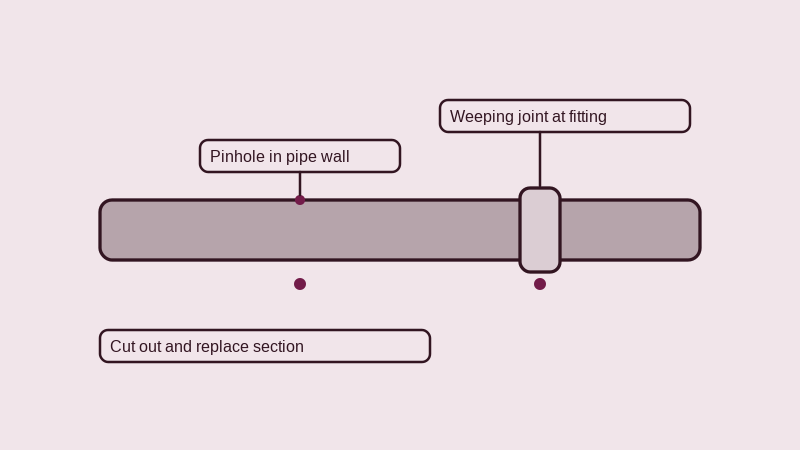
Shut the nearest isolation valve, or the main if that one is hidden, then empty the pipe by opening whichever faucet sits lowest in the home. Wipe the pipe dry and inspect it carefully. A pinhole or crack in the pipe wall needs a section replaced, while a weeping joint usually needs the fitting redone. Clamps and tape only buy time.
Start by working out what the pipe is. White or cream rigid pipe is usually PVC, which carries drains and cold supply. Light yellow or tan rigid pipe is often CPVC for hot and cold supply. PEX is the flexible tubing that comes in red, blue or white. Gray flexible pipe from older homes can be polybutylene, and that one should not be patched as a long-term plan.
Matching the repair to the pipe matters more than the brand of the product. PVC and CPVC use solvent cement and a different primer or cement for each. PEX uses crimp rings, clamp rings, expansion fittings or push-fit connectors, and every system calls for a dedicated tool. Mixing parts between systems is how a good repair becomes the second leak.
What can you use to stop a leak until the repair is done?
To get through a few hours or a day, a small leak on a dry pipe can be slowed or halted with silicone self-fusing tape, a stainless steel repair sleeve or a rubber patch held by a hose clamp. These are stop-gaps, not repairs. If you can, keep the supply closed until the repair is done, and set a bucket and towel beneath the spot.
Self-fusing tape works by stretching it hard as you wrap, with overlap each pass, over a pipe that is clean and dry. It copes with weeping and small pinholes at low pressure and not much else. Epoxy putty needs a dry surface to bond, which is exactly what a live leak will not give you.
Be careful on hot lines. A product rated for cold supply may soften or let go on a hot water line, and a surprise release of hot water is a scald risk. If the pipe is warm to the touch, regard the patch as extra temporary and stay clear of that area until the supply is closed.
What if the plastic pipe is leaking outside?
Outside, shut the supply using the valve at the house or in the meter box, then decide whether the line is a pressurized supply pipe or an irrigation line. A cracked sprinkler pipe can often be fixed with a slip repair coupling and a short piece of matching pipe. A wet patch over a buried supply line is a different job.
Sun is the common enemy of exposed plastic. Years of ultraviolet light make it brittle, so a line that has been fine for a long time can crack when a lawnmower, ladder or gardener's boot touches it. Pipe along fences and the side of the house takes the worst of it. Painted or wrapped pipe lasts better than bare plastic in full sun.
If lawn or soil is soggy with no sprinkler running, the ground is sinking, or your water meter keeps moving with everything inside switched off, the break may sit along the supply run from meter to house. That means digging, and digging starts with finding where other lines and cables run first. Hand the job over rather than guess with a shovel. To confirm a hidden leak at the meter, read the guide on why water bills run so high.
How do you stop water leakage from a tap?
A drip from the spout usually means the washer or cartridge inside the faucet has worn out, whereas seepage around the handle or base suggests a worn O-ring or packing nut. Close the little valve beneath the sink, dismantle the handle and note the sequence, then fit an identical replacement for the worn piece.
Bring the old piece to a hardware store, or jot down the brand and model stamped into the faucet body. A ball, a disc and a ceramic cartridge look alike yet cannot be swapped. Lay the parts out in order on a towel to make reassembly easy, and plug the drain so a tiny screw cannot vanish.
When the water is coming from below the sink, inspect the flexible supply lines and the nuts on each end. A compression nut often needs just a quarter turn extra, snug but not cranked. A braided line that is kinked, rusty or bulging should be replaced rather than tightened. With an old faucet whose parts are scarce, a new faucet may cost less in time than hunting for the right washer. Our guide to what a faucet installation costs lays out what the job involves.
How are the pipes arranged in a mobile home?
Like any house, a mobile home relies on supply, drain and vent systems, but here the pipes sit in the floor or belly of the home and are exposed to the weather around the skirting. Supply is often PEX or older rigid or flexible plastic, with drains in ABS. Insulation and heat tape protect lines from cold nights.
Because the pipes run beneath the structure, a leak can drip for weeks without showing indoors. Soft flooring, a musty smell or a patch of green under the skirting are clues. Moisture frequently runs along a joist before showing itself, so the damp patch is not always right over the leak.
Readers also ask about how to install plumbing under a mobile home. That work needs belly access, supports at proper spacing, frost protection and often a permit, and the details depend on the park and the building office. This page does not walk you through it. Before starting, ask your city or county building department whether a permit applies, and ask the plumber about insulation plans.
What is involved in repiping an older home?
New plumbing in an older house means cutting into walls or ceilings to run fresh pipe, usually PEX or copper, and then patching the openings. Duration and price depend on the home's size, its fixture count and how easy the walls are to reach. A plumber should handle it; this is no weekend project.
Older homes around Casa Conejo and Wildwood may carry galvanized steel or copper supply lines, and homes built from the closing years of the 1970s to the middle of the 1990s may contain polybutylene pipe, which is known to fail at its fittings. Looking at the meter run and the first exposed pipes beneath the sink or beside the water heater usually lets a plumber tell you which type you have.
When the pipes are sound and only one run has failed, replacing that run may be enough. When leaks keep appearing, or the water runs brown, pressure keeps dropping and several fixtures are affected, a whole-house repipe is worth pricing. Read about repiping a house and compare a PEX and copper repipe before you ask for quotes.
When is it time to hand the job to a plumber?
Get a plumber when the leak is inside a wall, ceiling or floor, the pipe runs under a slab, a patch will not hold, the line carries hot water or gas, or you cannot find the shut-off valve. A leak you can neither see nor reach cannot be properly repaired.
Safety sets limits too. Water and electricity are a bad mix: should water be running near an outlet, panel or light fitting, turn the breaker off, but only when it is safe to reach, and stay away if it is not. Should you ever smell gas, get out of the building and contact SoCalGas at 1-800-427-2200 from outside; 911 is for anyone in danger.
Speed counts: the EPA puts the water lost to leaks in a typical home at over 9,300 gallons a year, and a hidden leak can soak insulation and framing too. Describe the leak in the quote form. It is forwarded to local plumbing businesses, and the ones that accept requests pay us a fee. We read form requests on weekdays from 9am until 5pm.
Common questions
Can I glue plastic pipe while it is wet?
Not for a lasting repair. To fuse the plastic, solvent cement requires a joint that is clean, dry and properly prepared, and moisture weakens the bond. Empty the line, dry both pipe ends and allow the cement the cure time printed on its can before restoring the water. A joint made wet often leaks again under pressure.
Can a cracked plastic pipe be fixed without cutting it?
For a short time, yes, with a clamp, sleeve or tape. For anything lasting, no. A crack is a failure in the pipe wall, and the sound approach removes the damaged length and joins in new pipe with couplings of the same system. Repair couplings let you do this when the pipe cannot be moved far.
What is the way to locate a leak that is out of sight?
Switch off every fixture, note the water meter reading, wait an hour or two without using any water, then check the reading again. A change means a leak somewhere. Running toilets are the commonest culprit, so begin there by adding a few drops of food coloring to the tank. A meter that still moves after that points to a leaking pipe.
Should I replace polybutylene pipe before it leaks?
Many plumbers suggest planning for it, because the gray pipe is known for failing at fittings and replacing it on your timing costs less than damage. You do not have to rush on the day you find it, but get a plumber to check the home and talk through a repipe if you see gray flexible pipe near the meter or water heater.