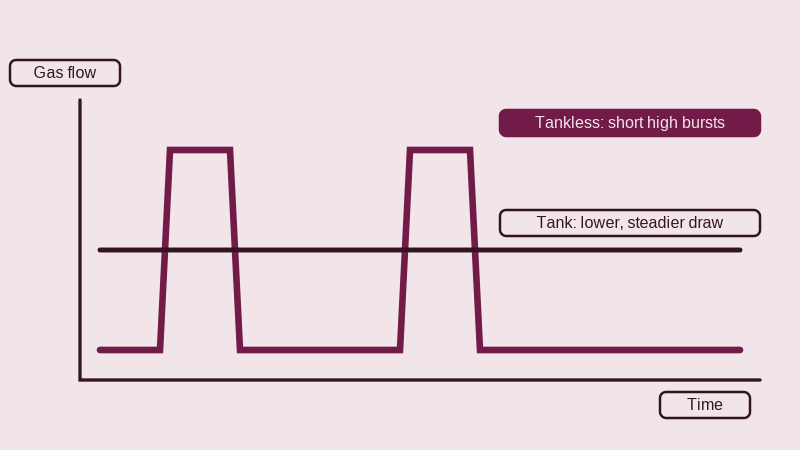
A gas tankless heater gives endless hot water within its flow limit and wastes less energy keeping a tank warm. A gas tank costs less, tolerates a modest gas line and recovers quietly. The better pick depends on your gas line, your vent path and how many taps you run together. This sits within our water heater service topic, and the price request page gets a plumber out to inspect your house.
How do gas tankless and gas tank heaters compare?
Gas tankless pros: continuous hot water, no standby loss, smaller footprint, and parts that can be serviced. Cons: higher purchase and install cost, bigger gas line demand, venting changes, a flush routine and a short delay for hot water to arrive. Gas tank pros: lower cost and familiar service. Cons: finite hot water, standby heat loss and a tank that eventually fails.
Side by side:
| Point | Gas tankless | Gas tank |
|---|---|---|
| Hot water supply | Continuous within the unit's flow rating | Limited to the tank, then recovery time |
| Standby heat loss | None | Yes, all day |
| Space | Wall mounted, compact | Floor standing cylinder |
| Gas line demand | High burst of gas | Lower, steadier draw |
| Venting | Often special venting, sometimes plastic if condensing | Usually a metal flue to the roof, or a power vent |
| Failure mode | Parts fail, unit can be repaired | Tank corrodes and leaks |
| Maintenance | Descaling and filter cleaning | Tank flushing and anode rod checks |
None of these points is a deal breaker on its own. Weigh them against your house.
Does gas tankless really save energy?
Usually it uses less gas than a tank for the same hot water, because it does not keep a reservoir hot all day. The saving is larger in a household that draws hot water in brief bursts and smaller in a household that runs hot water constantly. We do not quote a percentage, because the answer varies with the model and the household's habits.
Efficiency labels help. A condensing tankless model extracts extra heat from exhaust and typically shows a higher efficiency rating than a non-condensing one, and some gas tanks are also high efficiency. Compare the energy ratings on the yellow label, not just the type. Real savings also hinge on how well the unit is maintained, since a scaled heat exchanger loses efficiency.
If you are weighing cost against savings, compare a quote for each over the years you expect to stay. Our guide to tankless installation cost shows how a quote is built.
Will my gas line support a tankless unit?
Maybe not without changes. A tankless unit asks for a large burst of gas when it fires, more than a typical tank, so the line must be sized for the length of run and the other appliances. Older houses with a small line to the heater often need an upgrade. A plumber calculates this from the unit's input rating.
California regulates gas piping, which means only a contractor should handle it. SoCalGas is the utility where your street has service, and the meter size matters too. The gas line cost guide covers line sizing, and flexible gas connectors are explained separately.
A gas smell at any time means leaving the building; from outside, use 1-800-427-2200 to reach SoCalGas, or 911 for danger. Switch nothing on or off.
What about venting and carbon monoxide?
Gas heaters make exhaust that must leave the building. Tank heaters usually use a metal flue to the roof. Tankless units often need dedicated vent pipe, which may be plastic for condensing models or stainless for others, and may exit through a wall. A poorly fitted vent is a carbon monoxide risk, so venting should never be a do-it-yourself task.
Install carbon monoxide alarms near sleeping areas whichever you choose. If an alarm sounds, get everyone outside and ask the gas utility or the fire department for help. Older homes in Thousand Oaks and Newbury Park often have an existing roof flue that suits a tank but not a tankless, so a switch means a new route. Ask what will be done with the old flue.
How do earthquakes and shutoff valves come into it?
California homes sit in earthquake country, so the heater should be braced, and a gas shutoff that can be closed fast matters. A tank is strapped to the wall. A tankless unit is wall mounted and bolted, and flexible connectors allow some movement. An automatic shutoff valve on the gas line is a further safety measure to discuss.
Ask how the plumber will secure the unit and whether a seismic gas shutoff suits your meter. The page on gas shutoff valves for earthquakes covers the topic. Permits apply when a gas heater is replaced, and the office is City of Thousand Oaks Building and Safety for city addresses, or the Ventura County Resource Management Agency for unincorporated areas such as Lake Sherwood.
How does daily use feel different?
A tankless unit has a short wait while it fires and the water heats, and it needs a minimum flow to start, so a barely open tap may run cold. A tank gives hot water instantly from the top, until it runs out. Tankless can deliver a long shower and a second shower together, as long as flow stays within limits.
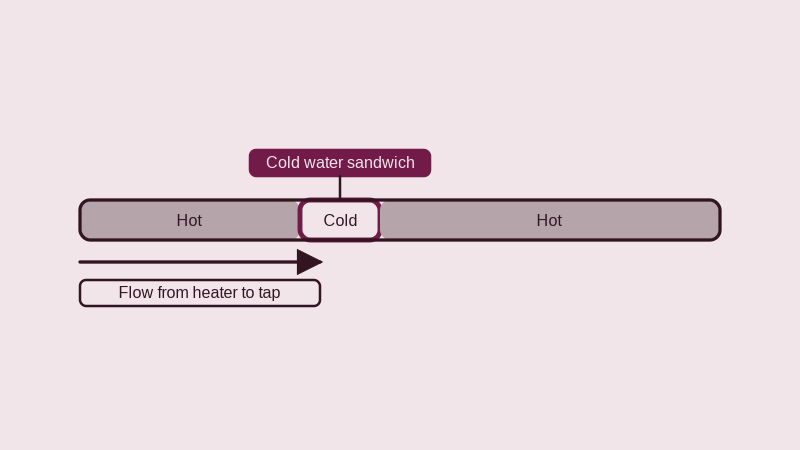
Two quirks are worth knowing. First, after a brief shutoff, a cold slug of water can arrive between hot draws, known as the cold water sandwich. Second, running a tap very low can fail to trigger the burner. A recirculation setup can shorten the wait, but adds cost and gas use. If your kitchen is far from the heater, ask about a small mini tank at that sink instead, which our comparison page describes.
Which one fits a typical Conejo Valley house?
Tankless is a strong option for a large family with a generous gas line and a heater located in the garage. A gas tank is a reasonable choice if the line is small, the vent is awkward, or you want the lowest cost now. Newer homes in Dos Vientos and North Ranch often suit either. Ask the plumber to check your line first.
To decide when to replace the old unit, read the water heater lifespan guide. To have a plumber look over the house, send a quote request and mention which type you favor.
Common questions
Can a gas tankless unit replace a gas tank where it stands?
Often yes, provided the gas line can supply the burst and the vent can be reworked. The plumber checks line size, vent route, clearances and the drain for condensation. Sometimes the unit moves to an outside wall to simplify venting. A quote should list those changes separately so you can compare options.
Is tankless better for a big family?
It can be, because supply does not run out, but each unit has a flow limit. If two showers and a dishwasher run together, a single unit may fall short, and two units or a larger model may be needed. Add up your peak flow before choosing, using the manufacturer's rating.
How long do gas tankless and gas tank units last?
Tankless units commonly outlast tanks when they are descaled on schedule, though tanks vary widely. Lifespan depends on water hardness, upkeep and use. A figure for your house is not something we can give. See our replacement timing guide for the checks that matter.
Do I need a permit?
For a gas water heater replacement, California generally calls for a permit and an inspection, and bracing is expected. The plumber typically handles the permit, but confirm it. For city addresses, ask City of Thousand Oaks Building and Safety. For unincorporated areas, the Ventura County Resource Management Agency handles it. Skipping a permit can create problems with insurance and when selling.
Who arranges the installation?
We arrange for a nearby plumber to visit and give a written quote. Put the details of your heater and gas meter into the quote form. The plumber, not us, carries out the work. Return to Conejo Plumbing Pros to browse other pages whenever you like.