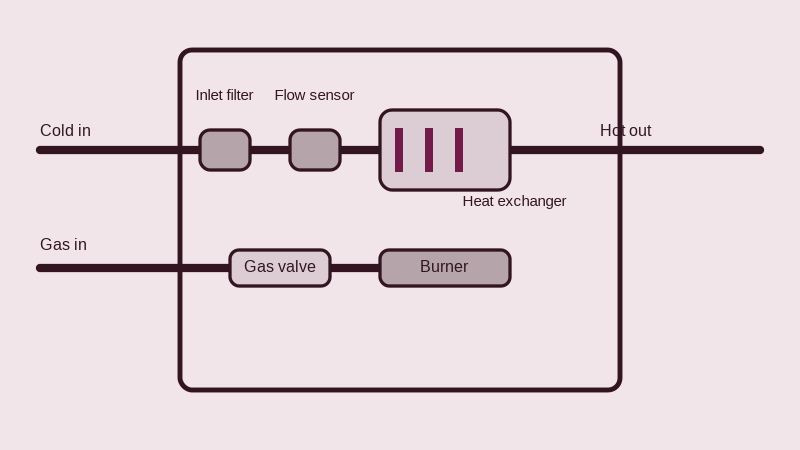
When a Rheem tankless water heater stops making hot water, the cause is usually power, gas, water flow, venting or scale. Some checks take minutes. Anything inside the gas train or the burner needs a plumber. Our water heater repair page lists the full range of heater jobs we can arrange.
Tankless units heat on demand, so they fail differently from a tank. There is no stored supply to hide a fault, and a unit that stops will usually say why on its display. Reading that code is your first job.
Why has my Rheem tankless heater stopped heating?
Common causes are no gas or a closed gas valve, a tripped breaker or no power, a clogged inlet filter, low flow through the unit, a blocked vent, or heat exchanger scale. Read the code on the screen first, then check the gas valve, the power and the water supply before concluding the unit has failed.
Make sure the gas shutoff handle is parallel to the pipe, the power cord or breaker is on, and the hot tap is open fully, since a tankless unit needs a minimum flow before it will fire. If a single faucet runs lukewarm while others are fine, the problem may be that faucet's mixing valve, not the heater. For no-heat problems in general, see no hot water causes.
Should you repair or replace it?
Repair makes sense when one part has failed, a sensor, igniter, fan or flow sensor, on a unit that is otherwise sound. Replacement deserves discussion if the exchanger has failed, the unit is aging and breaking down repeatedly, or parts are scarce. A plumber can supply a written comparison.
Ask how old the unit is, what the warranty status is and whether parts are available. Compare the repair price with a new unit's price, including permit and venting work. For the replacement side, see what a tankless replacement costs and our tank versus tankless guide.
Is scale the problem, and does hard water cause it?
Heat exchanger scale is a leading cause of poor output in tankless units, and hard water makes it worse. The US Geological Survey explains that heated hard water forms calcium carbonate deposits that can shorten equipment life and lower efficiency. A scheduled flush with a descaling solution is the usual cure.
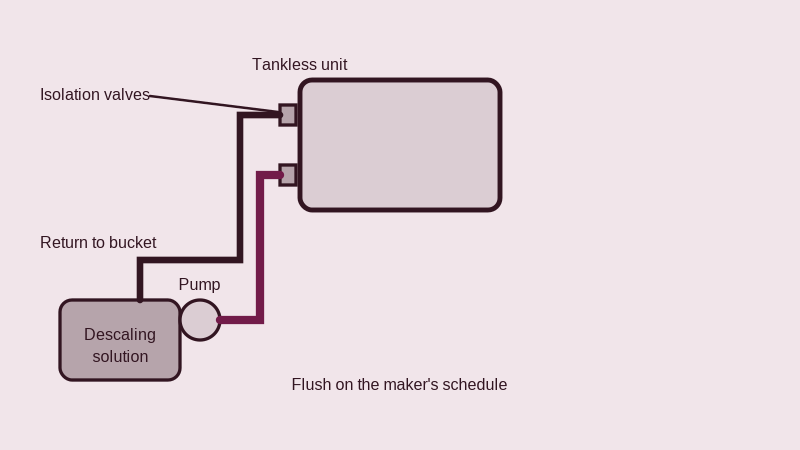
Many Rheem models have isolation valves that allow a plumber to flush the unit using a pump. The interval depends on your water; ask the supplier for its hardness report and follow the manual's maintenance schedule. A softener upstream cuts the build-up, and the guide to preventing hard water scale explains how.
What can an owner check safely, and what needs a plumber?
The display, the power supply, the gas valve handle, the inlet screen and the faucet are all safe for you to check. Do not open the burner compartment, adjust gas pressure, repair vent joints or touch the gas train. Gas work and venting changes belong to a contractor with the proper California license, and sometimes need a permit.
Smelling gas means getting out first; once outside, reach SoCalGas on 1-800-427-2200, and use 911 if anyone is in danger. Never light anything nearby. Condensing models, which some Rheem lines include, also have a condensate drain and neutralizer that can clog, and clearing that is a plumber's task. If the unit leaks, close the water and gas supplies, then send a request.
How should I read Rheem error codes?
Rheem codes point to a system: ignition, flame, flow, venting, temperature or sensor faults. Your model's own manual lists each code, so read it before acting. Many codes clear after a single reset, done by turning the unit off and back on. A code that comes back after a reset needs a plumber.
Avoid repeated resets on a unit that keeps showing the same code, since each attempt can fire the burner under a fault. Note the code, the model number on the rating plate and what happened right before it stopped. Handing a plumber that note saves time. We cannot interpret codes for a model you have not named, so the manual is the authority here.
Common questions
How long does a tankless heater repair take?
Flushing off scale or swapping a part on an accessible unit is often a visit of a couple of hours. A fault that needs a part ordered takes longer. Gas or venting repair can add inspection time. Once the plumber has read the code and looked at the install, a better estimate is possible.
What should I ask before hiring for this?
Ask whether they service Rheem units, if the quote includes diagnosis and parts, what the warranty status of the unit is and what happens when a part is not in stock. Have the price written down ahead of the job. Settle all of that before booking.
Can I fix an error code by resetting?
Sometimes. A single reset can clear a one-off fault from a power glitch or a brief flow dip. If the code comes back, stop resetting and send a request, since repeated firing attempts under a fault can damage parts or create a safety problem.
Does a leak from the unit mean it has failed?
Not always. A leak at a connection or the condensate line is fixable. A leak from inside the unit, such as the heat exchanger, usually means replacement. Shut off the water supply and gas, then send a request with a description of where the water appears.
Is yearly service worth it?
For most homes with hard water, yes. Scale builds silently, and a yearly flush protects the heat exchanger and keeps flow steady. Check the manual for the interval for your model and water, and keep a record of each service.