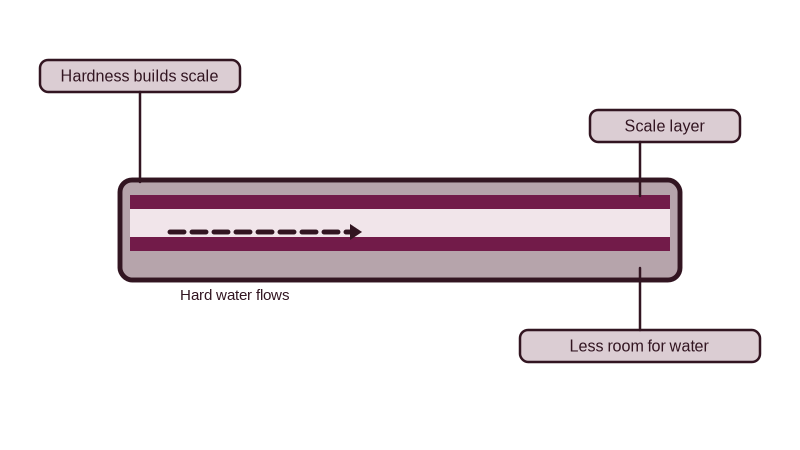
Preventing scale means taking out the minerals behind it, calcium and magnesium, altering how they behave, or cleaning on a schedule. A salt based softener removes them. A conditioner leaves them but alters how they stick. Regular flushing and descaling handles what is left. Which is worth it depends on your hardness number, and we explain how to read it below.
Softener installs and heater service are arranged across Thousand Oaks and the surrounding Conejo Valley, and the full list is on the home page. This page is the plain explanation of scale and your options.
Where does hard water scale come from?
Scale is the chalky layer left behind by calcium carbonate. USGS says heating hard water can create solid calcium carbonate deposits that cut equipment life, push up heating costs and clog pipes. It forms fastest wherever water is heated or dries off: inside water heaters, on faucet tips, shower heads, kettles and glass.
You see it as white crust on a shower head, spots on glass, a ring in the toilet bowl and a stiff, soapy film on skin. You do not see it inside a tank heater, where it settles as sediment at the bottom and as a coating on the heating element. A tank that rumbles when it heats often has a layer of scale or sediment. For heaters, see water heater lifespan.
Which water supplier serves my home?
In Westlake Village and Agoura Hills the supplier is reported to be Las Virgenes Municipal Water District, while many Hidden Valley homes rely on private wells. In Thousand Oaks and Newbury Park, check the name on your water bill. We have not confirmed the supplier for every area, so your bill is the source to trust.
Wells matter because well water has no public report. A homeowner on a well should have the water tested by a laboratory, which reports hardness, iron and other things that affect softener choice. Las Virgenes Municipal Water District's own site is www.lvmwd.gov.
How can existing scale be removed?
Soak fixtures in white vinegar, wipe, and rinse. Tie a vinegar-filled bag around a shower head for an hour. For inside a heater, sediment and scale need a flush, and thick scale on a tankless exchanger needs a descaling pump. Removing hard water scale walks through cleaning step by step.
Keep vinegar off natural stones like marble and travertine, and do not mix it with bleach. If a faucet is crusted solid, replace the aerator before you replace the faucet.
To get a softener quoted, send the quote form. A plumber confirms the size and the layout at the visit.
What are the ways to prevent scale in pipes and heaters?
Four ways work, and many homes use two together: a salt based softener for the whole house, a scale conditioner or template assisted crystallization unit, flushing the water heater and descaling a tankless one on a schedule, and fitting a tank heater with an anode rod that is checked now and then. A softener is the only one that removes hardness.
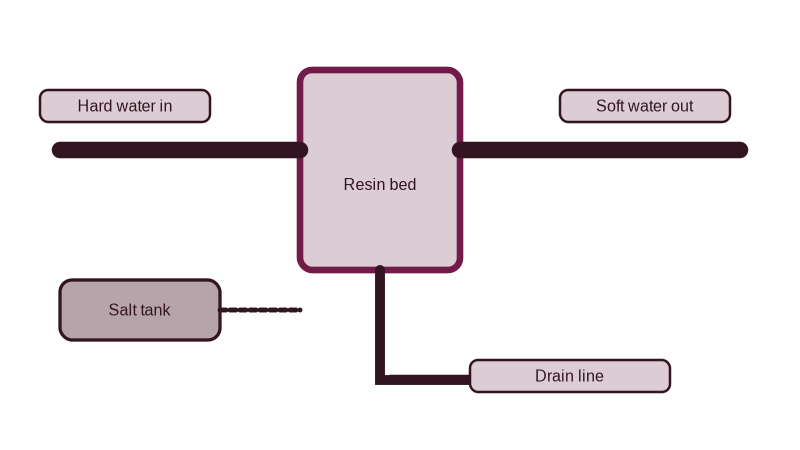
Softener. An ion exchange unit replaces calcium and magnesium with sodium or potassium. It protects heaters, pipes and fixtures, and softer water means less soap. It needs salt, a place to drain and an electrical outlet close to the water main. See how a softener install goes and the softener installation service.
Conditioner. These units claim to turn dissolved minerals into small crystals that stay suspended and stick less. They add no salt and need no drain. Opinions on how well they work differ, so ask for the product's test data and the return terms before buying.
Flushing. Drain a few gallons from a tank heater every year or so to move sediment out. A tankless unit is flushed with a descaling solution using a pump and hoses, per the maker's manual.
Anode rod. The rod in a tank heater wears away to protect the tank. Anode rod replacement explains when to check it.
Does a softener raise my water bill?
Recharging uses a little water, so a very small rise is possible. The bigger worry is a faulty unit that cycles constantly or a drain line that runs without stopping. If your bill jumps after an install, check the recharge settings and look for a running drain. See softeners and high water bills.
How is hard water measured, and what does the hardness scale mean?
Hardness is the amount of dissolved calcium and magnesium, reported in milligrams per liter (mg/L, the same as ppm) or grains per gallon. USGS classes 0 to 60 mg/L as soft, 61 to 120 as moderately hard, 121 to 180 as hard and more than 180 as very hard. Your water supplier publishes its number in a yearly water quality report.
Check which unit your report uses before comparing. If it says grains per gallon, a conversion chart is needed, and we have not checked one for this page, so use a calculator from your water provider. A few more points:
- ppm and mg/L are the same measurement for this purpose.
- pH is not hardness. It measures acidity. Water can have a normal pH and still be hard.
- TDS (total dissolved solids) includes more than hardness, so a high TDS reading does not tell you the hardness on its own.
- Test strips from a hardware store give a rough band, not an exact number. A water report is better.
We have not found a hardness figure for any Conejo Valley area that we can cite, and supplies differ by street. Ask which provider bills you and request its latest report.
Do you need a water softener or is cleaning enough?
If your report shows hard or very hard water and you have a tank or tankless heater, a softener is usually worth pricing. If it is moderately hard, regular descaling and a conditioner may be enough. Fixtures and spots alone are a cosmetic matter. Heater damage and clogged pipes are the reasons to act.
A rough decision guide:
| Water hardness | Typical choice |
|---|---|
| Soft (0 to 60 mg/L) | Nothing needed |
| Moderately hard (61 to 120 mg/L) | Flush the heater, clean fixtures with vinegar |
| Hard (121 to 180 mg/L) | Softener or conditioner, descale tankless units |
| Very hard (more than 180 mg/L) | Softener, plus heater service on a schedule |
The bands come from USGS. The choices are ours and are a guide, not a rule. A plumber looking at your actual pipes and heater can tell you more. For installation prices, read the cost of a softener install and the whole-house version.
Common questions
How much time does a softener installation need?
Most installs take a few hours, at most half a day once the plumber is on site, and longer if new plumbing, a drain or an outlet has to be added. Once the plumber has seen where the water main is and how much room the unit has, a time window can be given. The water will be shut off for part of the visit.
What should I ask before hiring a softener installer?
Find out the hardness your system is sized for, the model and salt type, where the drain will go and what the install covers, and get the price in writing. Confirm if a permit applies and where the old unit will go. Also ask who services the system if it fails.
Do I have to be at home during a softener install?
Yes, an adult needs to show the plumber the water main, the garage or utility space and the outlet. The supply is shut off briefly while the work goes on, so schedule around it. Before the plumber arrives, make room around the install point.
Is a hardware store test strip accurate enough?
It gives a rough band, enough to see whether your water is soft or hard, but not enough to size a softener. Use your water supplier's yearly report or a laboratory test instead, particularly on a private well, where no public report exists.