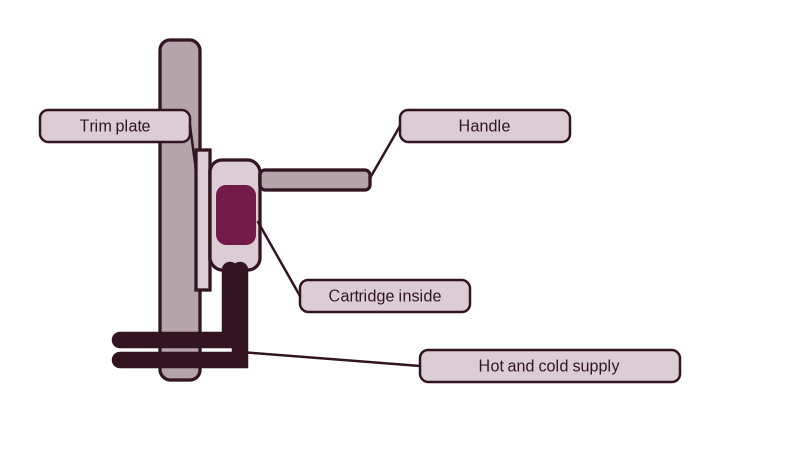
A shower faucet that drips, or runs weakly when it should be off, almost always has a worn cartridge or stem in the valve body that hides under the handle and trim plate. The remedy is to close the water, pull the old part and fit an identical new one. Shower valves sit in the wall, so access and shut-off are the hard parts. This page sits alongside our wider faucet, sink, shower and disposal pages. It also helps you tell a simple swap from a job for a local plumber.
Why does the shower keep dripping when off?
The valve behind the handle has stopped sealing. A single-handle shower usually needs a new cartridge, while a two or three-handle shower needs a stem washer or seat. Dripping from the showerhead for a few seconds afterward is just the pipe draining, which is normal and not a leak.
Look for a steady drip, not a last trickle. Water still arriving a minute after you stop means the valve leaks. When the drip is at the tub spout as the shower runs, the diverter may be worn and the shower valve is fine.
Mineral buildup matters. Scale roughens the sealing surfaces and the showerhead's holes, so cleaning can cure a spray problem but not a failed cartridge. An ignored drip wastes water all day, and the EPA puts yearly leak waste in the average household above 9,300 gallons.
What should you gather before starting?
Gather a screwdriver set, an Allen key, pliers, a cartridge puller if your valve takes one, a replacement cartridge or stem kit for your brand, a rag and some plumber's grease. Closing the water comes first: use the shower's own stops where they exist, and otherwise shut the house main.
Many older Conejo Valley homes have no stops at the shower, so the main shut-off is the only choice. Locate yours and test it beforehand, because discovering a stiff valve mid-repair is unpleasant. Stuff a rag in the tub drain so screws do not vanish.
Work out the brand from the handle or trim plate, since fixtures from different makers do not interchange. Delta, Moen and others use different cartridges. Take a clear photo of the handle and the inside once removed. A parts store or manufacturer diagram will match your valve to its parts.
How do you replace a worn shower cartridge?
With the water off, pry the cap off the handle and unscrew it, then lift away the trim plate. Take out any retaining clip or nut and pull the cartridge straight out. Install the new one in the same orientation, put the clip and trim back, and turn the water on slowly with the handle open to flush debris.
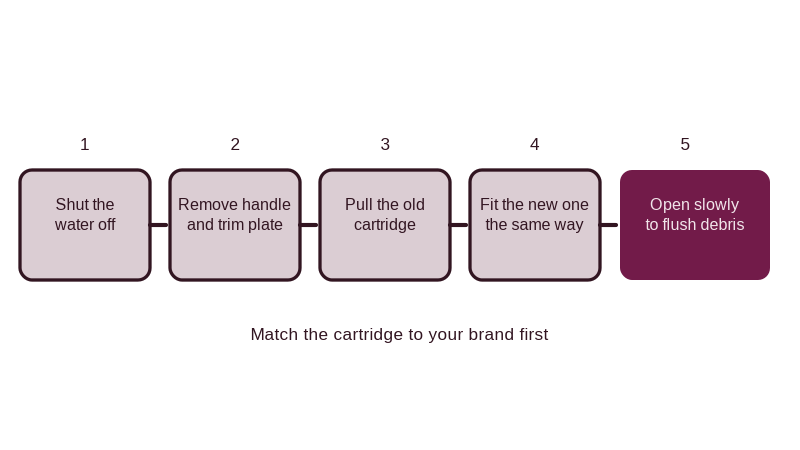
Orientation is the usual mistake. Many cartridges have a tab or notch that sets the hot and cold direction, and fitting one rotated gives backwards temperature or a short range. Mark where the old one sat before pulling it. Go easy with grease on the O-rings.
If the cartridge is stuck, a puller tool avoids twisting the valve body. Do not pry with a screwdriver against the wall, because a cracked body means opening the wall. Our guide to a leaky Delta shower faucet covers one common brand, and a general leaky faucet guide explains the other faucet types.
What about a two-handle shower or a tub spout that drips?
For two-handle showers, replace the stem washer and seat or the whole stem for the leaking side. For a tub spout that leaks, check the spout's O-ring and connection to the wall. A diverter that does not hold sends water to the tub while the shower runs. Spouts usually unscrew or release with a set screw.
Look under the spout for a small hex screw. If there is none, the spout may screw straight on and turn counter-clockwise. Check the threads for old tape or caulk. A leaking tub faucet also has its own page, titled repairing a leaky bathtub faucet.
How can you tell whether the leak is in the wall?
Stains on a ceiling below, a soft wall near the shower, a moldy smell or water at the access panel suggest the leak sits in a pipe or joint behind the valve. Stop using the shower and shut off its supply. Never open walls blindly. A plumber can test the line and locate the leak.
Our guide to a plumber for a shower leak explains the tests, including pressure checks and moisture readings. Leaks in walls above finished rooms, or in houses on slab foundations, need extra care. If the leak is beneath concrete, see finding and fixing slab leaks.
Older homes in Thousand Oaks and Newbury Park built across the 1960s through the 1990s may have original copper or galvanized lines behind showers. These can corrode at joints. A plumber should judge if the valve is the only worn part.
At what stage should a plumber step in?
Hand it to a plumber when the water cannot be stopped, the valve body is cracked or corroded, the leak is behind the wall, no kit fits the parts, or you want a new valve with fresh shut-offs. Replacing a valve means cutting into the wall and fitting or soldering a new valve body.
We do not do plumbing ourselves. Conejo Plumbing Pros arranges a visit and quote from a local plumber. Plumbing work above a small-job threshold needs a California contractor license, which you can look up at cslb.ca.gov. Send details and a photo of the trim plate through the quote form. Replacing a valve behind tile may involve tile repair, so ask the plumber if that is part of the price.
Common questions
How much time should a shower leak repair take?
A cartridge swap can finish in under an hour once the water is off, though seized parts can stretch that. Replacing a valve behind a tile wall takes much longer, and tile repair may be a separate job. Ask the plumber for a time estimate that includes any wall repair.
Which questions are worth asking before a shower leak repair?
Check whether the quote covers opening up the wall and closing it again, who fixes tile or drywall afterward, how large the call-out charge is, and whether parts are included. Ask for the contractor license number and verify it at cslb.ca.gov. Insist on a written quote.
Must I be present for the repair?
Generally yes, at least early on, so the plumber can view the shower, settle the price and find the shut-off. Clear the bathroom of towels and bottles. If the wall behind is reached via a closet or neighboring room, sort out that access too.
Can I do this without shutting off the whole house supply?
Only when the shower has its own stops, which newer valves often hide at the trim. Many older showers have none, so the main must be closed. If neither option works, stop there. Ask a plumber to fit stops while the valve is open.
Why does hot water mix into the cold at the shower?
A worn cartridge or a faulty mixing valve can let hot and cold cross over. If other fixtures are fine, the shower valve is the likely cause. Our page on a shower that never gets hot covers the related problem.