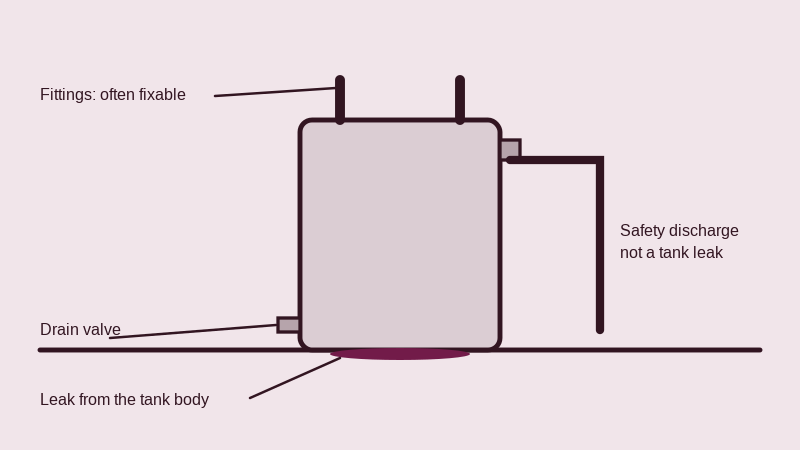
A leaking water heater calls for three quick steps: close the cold water valve above it, turn off its gas or breaker, and line up a plumber. A fitting or valve that leaks can often be repaired. Water coming through the tank body is different, because it means the tank has failed and the unit must be replaced. The water heater repair page shows the full range of jobs.
A puddle beside a water heater does not always come from the heater. Condensation, a dripping supply line and a weeping relief valve all look alike for the first minute. Find the source before deciding what to order.
What makes a water heater leak, and is a repair possible?
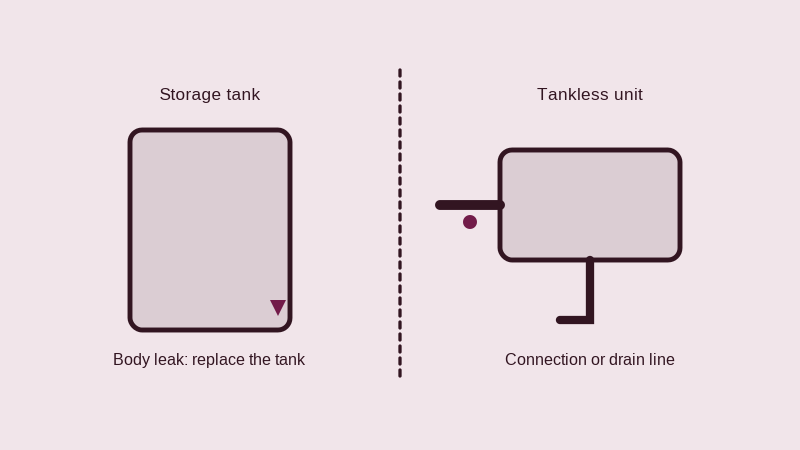
The answer follows the source. Leaks at a connection, drain valve, anode port or relief valve are often repairable. Water from the tank's bottom or from under the jacket usually means the inner tank has corroded through, and no repair holds. Tanks do not heal. A plumber confirms the source and tells you which case you have.
Trace the water's path. Wipe the unit dry, then watch for the first drip: pipe joints on top, the side valve, or the base. Discharge from the relief valve, which travels down a pipe to the floor, can resemble a tank leak but is a safety device doing its job, often after pressure builds. The page on water heater relief valve replacement explains why.
Rusted-out tanks are also the reason anode rods matter. They are sacrificial metal that slows internal corrosion, and a spent rod is one reason older tanks fail. See anode rod replacement if the heater is not yet leaking.
How should you respond while it is leaking?
Begin by closing the cold water inlet valve at the top of the heater. A gas unit needs its gas control turned to off. An electric unit needs its breaker flipped, but only when you can reach the panel standing on dry ground. If there is a gas smell, leave and contact SoCalGas at 1-800-427-2200 from outside, or 911 when anyone is at risk.
Never open the drain valve on a hot tank unless a hose leads to a safe drain, since the water scalds. Set a bucket or towels under slow drips and clear stored items. A heater in a closet or attic can send water into a ceiling below, so check the rooms underneath. That follow-on damage is covered in our guide to a leaking ceiling.
Does swapping a water heater need a permit?
Generally yes. California regulates water heater replacement, so the local building office usually asks for a permit and may send an inspector. Rules and fees vary by city and county, so ask the plumber who takes care of it. For most of Thousand Oaks that is City of Thousand Oaks Building and Safety; for unincorporated areas such as Oak Park, Lake Sherwood and Hidden Valley, the Ventura County Resource Management Agency.
Even a matching swap counts as permitted work. Inspectors look at the gas connection, the venting, seismic strapping, and the relief valve along with its discharge pipe. A plumber who skips the permit leaves you with an unpermitted heater, which can cause trouble at a sale or an insurance claim. The replacement cost page shows what a full swap involves.
Which code rules govern a water heater installation?
The California Plumbing Code, together with local amendments, sets the rules installers work to. In practice that means earthquake strapping, a relief valve for temperature and pressure piped to a safe discharge point, a supply shutoff, correct venting on gas models and enough room for servicing. Closed systems often need an expansion tank, though not always.
Gas models need a sound gas connection with a nearby shutoff, plus combustion air and a vent path suited to the model. Electric models need a correctly sized circuit. A garage location may bring a local rule to lift the heater off the floor. The expansion tank page explains when one is fitted. Work on gas piping is for a contractor with the proper California license, not for you.
How do tankless heaters differ when they leak or fail?
A tankless unit does not store hot water, so a leak is usually at a connection, an internal heat exchanger or a condensate line, not a tank failure. Gas tankless models need a larger gas line, a venting kit and sometimes a condensate drain. Condensing models recover extra heat from exhaust and produce acidic condensate that must be drained safely.
Installation manuals from makers such as Rinnai set out venting, clearances and gas sizing, and the plumber works from the manual for your model. Natural gas tankless installs often include a gas line upgrade, so ask for it in the quote. Hard water scale commonly hurts tankless performance; flushing and upkeep are listed in the maker's guide. For a model-specific page, see the Rheem tankless repair page.
What if the heater is cold but nothing is leaking?
A cold heater without a leak usually points to a failed heating element, a tripped breaker or limit switch, a gas supply problem, a pilot or ignition fault, or a thermostat issue. Check the breaker or pilot light first. If a gas heater will not light, or there is a gas smell, leave the building and contact SoCalGas.
On an electric heater, press the reset button one time and look at the thermostat setting. A heater that leaked before going cold may have shorted an element. Pilot and thermocouple faults are a common, cheap repair on older gas units; see thermocouple replacement. The no hot water guide lists more causes.
Common questions
How long does replacing a leaking heater take?
A standard tank swap is often a half-day job: the old unit is drained, the new one hooked up, venting connected and everything tested. Permit and inspection can stretch the calendar. A tankless install or gas line upgrade takes longer. The plumber can say once they see the existing setup.
What do I ask before hiring for a heater leak?
Ask whether the leak can be repaired, how the permit gets handled, whether the quote includes strapping, a new relief valve with its discharge pipe, and what happens to the old unit. Have the quote written down, and ask how the plumber will test the new connections before leaving.
Is a slow drip at the relief valve an emergency?
Not usually, but it should be looked at soon. It may be high pressure, thermal expansion or a worn valve. Do not cap the valve; it is there to prevent a dangerous pressure rise. If the valve is running continuously or the tank is bulging, shut off the supply and get a plumber quickly.
Can I move my water heater to a new location?
Moving a heater means rerouting water, venting and gas or electric supply, and may need new permits and clearances. This outweighs a simple swap and usually costs more, because pipes, vent and gas or power all move. Mention the move in your request so the quote reflects it, and ask who handles the permit.
Will insurance cover a leaking water heater?
A burst tank that causes sudden damage may be paid for under some policies, though the heater's own cost and slow leaks from wear are usually excluded. Read the policy wording on sudden versus gradual damage, take photos of the leak and the wet area, and keep the plumber's invoice. A written note from the plumber on the cause can help with a claim.