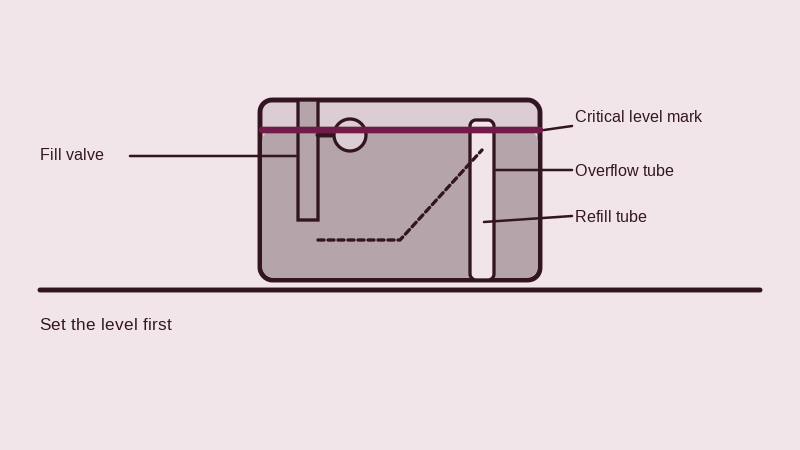
Standing tall inside the tank, the fill valve lets water in after every flush and shuts it off as the float rises. As it wears out, the toilet hisses, runs on, fills slowly or spills into the overflow tube. Replacement is a short job with basic tools. To hand it over instead, the home page has the request form for a local plumber.
Most of the repair is deciding if the fill valve is truly the problem. A flapper that lets water seep down to the bowl looks much the same from outside, and swapping the wrong part wastes time. Two checks settle it.
How do you tell the fill valve is the culprit?
Take the lid off, then flush. If water keeps rising up the overflow tube once the tank is full, or the valve hisses and refuses to close, the fill valve is the fault. If the level stays right but the bowl refills every few minutes, the flapper is the leaker.
Add a little food coloring to the tank and wait. The EPA says color reaching the bowl within 10 minutes signals a leak, which points to the flapper or seat, not the fill valve. A fill valve problem shows up as water rising too high, a constant hiss or a slow refill. Our page on toilets that keep running separates the causes, and flapper repair covers the other half.
How do you swap a toilet fill valve?
Shut the supply valve at the wall, flush the tank dry, and mop up any water left. Disconnect the supply line under the tank, undo the locknut beneath it and pull the old valve out. Place the new one at the correct height, snug the locknut by hand and add a slight turn, reconnect the line and reopen the water.
Compare the new valve with its instructions, since float height varies by model: the critical level mark usually sits above the overflow tube's top, so follow the maker's stated gap. Attach the refill tube's clip to the overflow tube, but do not push the tube inside it. Turn the water on gradually and watch for drips at the nut, since overtightened plastic cracks the tank. Keep a bucket and towel handy.
Budget 20 to 40 minutes the first time. The new valve costs far less than a service visit, which is why many homeowners do this themselves.
How do you choose the right fill valve?
Match the valve to your tank: a standard float-cup valve suits most tanks, a low-profile model suits shallow tanks, and a side-mount model suits some one-piece or pressure-assist designs. Check the shank height and the supply connection size. Choosing a replacement the same style as the original is the least risky option.
Float-cup valves are quieter and more compact than older ball-float designs. Look for a valve with an adjustable height, a refill tube clip and a metal or high-quality plastic base. Avoid buying a universal kit without checking that it fits your model. If the supply line itself is old and corroded, replace it too; our page on toilet shutoff valves explains what to check.
How do the flapper and its gasket fit in?
A rubber seal at the bottom of the tank is the flapper, and the gasket beneath the flush valve is the larger seal where tank meets bowl. A worn flapper lets water slip into the bowl. A failed tank-to-bowl gasket leaks onto the floor. Both are cheap parts, but the gasket repair means taking the tank off.
A flapper chain pulled too tight or left too loose is the easiest fault to cure: adjust it for a little slack. When replacing the flapper, match your flush valve size; two-inch and three-inch openings are the usual options. A leaking gasket calls for lifting the tank, replacing the bolts and reseating the washers. If water appears on the floor, see toilet leak repair.
Is a burst pipe from a toilet possible?
On its own a toilet seldom bursts a pipe, yet a stuck-open fill valve or a failed supply line can flood a bathroom. The braided supply hose fails most often. It can burst at the fitting and release a lot of water quickly, and the only remedy is closing the wall valve.
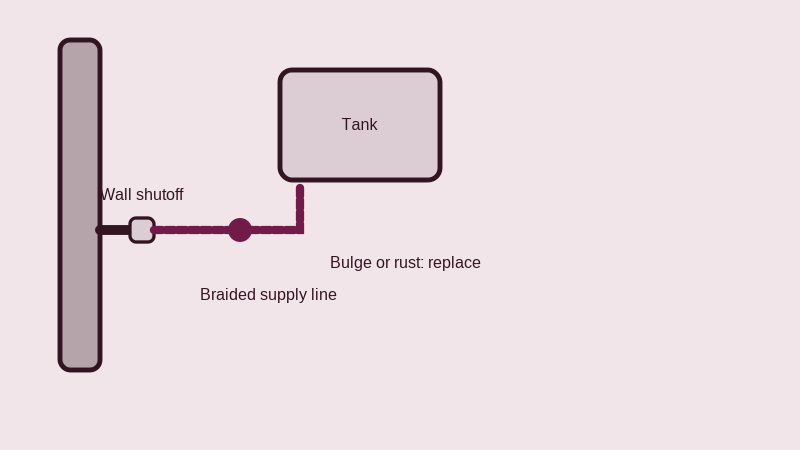
Replace a cracked, rusty or bulging supply line before it fails. The page on burst pipes covers what to do if one gives way, and water pressure regulators explain why very high pressure shortens the life of toilet parts. The brass wall valve can also seize, so work it once a year.
When should you hand it to a plumber?
Send a request if the shutoff valve refuses to close, the supply line is corroded or leaking at the wall, the tank is cracked, or water already covers the floor. Old homes in Thousand Oaks and Newbury Park sometimes have shutoff valves that snap when turned. A plumber can replace that valve and the fill valve in one visit.
Call a plumber as well when the toilet is loose, rocks, or leaks at the base, since that signals a failed wax ring and means pulling the toilet. And if several fixtures hiss or run, house pressure may be the problem rather than the toilet. The inlet valve repair page and the overflow tube guide go through related cases.
Common questions
How much time does a fill valve repair take?
Doing it yourself takes 20 to 40 minutes the first time, once you have the part. A plumber finishes in a short visit, with most of the time going to travel and fitting the shutoff valve if it needs replacing. Taking the tank off for a gasket adds time.
What should I ask before hiring someone?
Ask if the quote covers the part, the supply line and a new shutoff valve in case the old one fails. Ask about a minimum charge for a short visit, and whether the flapper gets inspected too. Get the price in writing before work starts.
Why does the toilet keep hissing after a new fill valve?
Usually the float is set too high, the refill tube sits inside the overflow tube, or debris is stuck in the valve. Lower the float, clip the tube above the overflow, and flush the line by opening the supply with the valve cap removed. If the hiss continues, the valve may be defective.
Does a burst toilet pipe count as an emergency?
If water sprays or pours onto the floor, yes: close the wall valve behind the toilet, or the main if that valve fails. Cut power if water reaches outlets. Once the water is stopped, a plumber can replace the line or valve at a normal visit.
Are special tools needed?
Pliers, a bucket, a sponge and a small adjustable wrench do the job. Keep a fresh supply line ready, since the old one often will not seal when reused. A toilet repair kit helps but is optional; matching the part to your toilet matters more.