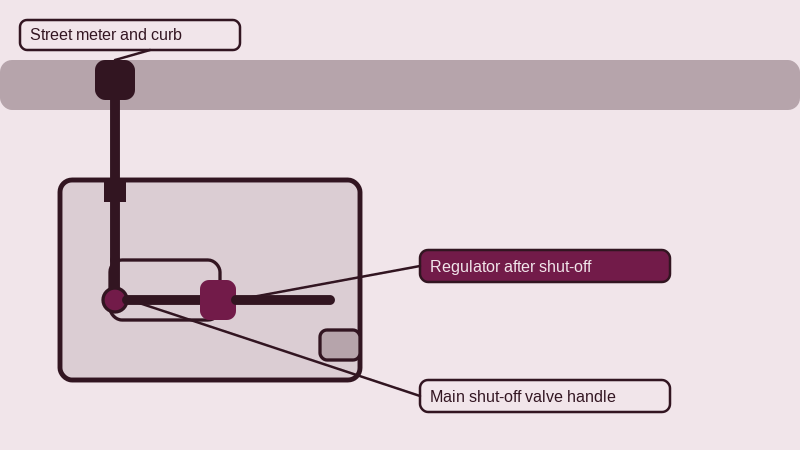
Most water pressure regulators are fitted to the main supply line directly downstream of the main shut-off valve, near the spot the pipe comes into the house. Check the garage wall, the front or side of the house by the hose bib, the area next to the water heater, or a meter box near the street. Expect a brass valve in a bell shape, topped with an adjusting screw. This page sits under low water pressure and valves, and helps you find, identify and read the pressure at your regulator.
Where do you usually find a pressure regulator in a house?
Trace the main supply pipe back from the point where it comes into the house. The regulator normally sits ahead of everything else downstream: look first in the garage, then on a side wall by the hose bib, in a utility closet or by the water heater. It is typically the first fitting beyond the main shut-off. In some homes it is below grade in a meter box at the property line.
The pipe usually arrives from the street meter, runs underground and rises near the front or side of the house, or through a garage wall. If the house has a slab, look near the outside hose bib nearest the street. Houses built into hillsides can have the entry point on a different side than you expect.
If you can find the main shut-off valve, you are close. The regulator is usually within a foot or two of it, downstream, which means toward the house. If the pipe is buried in a wall or cabinet, a plumber can trace it quickly.
What if you cannot find one?
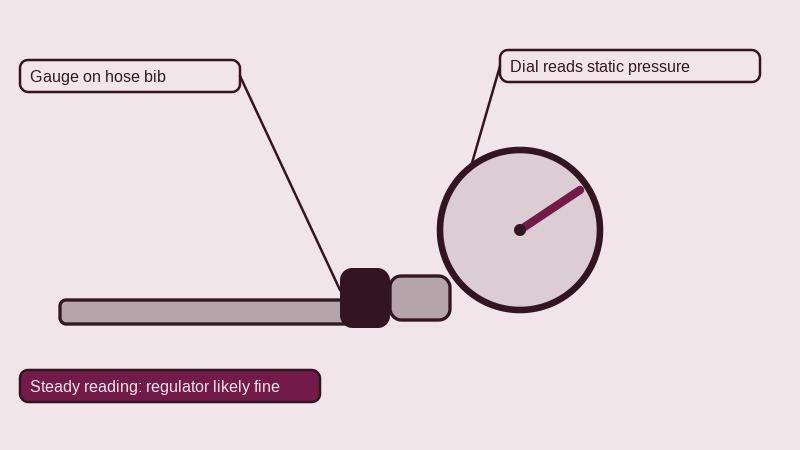
Some homes do not have a regulator, especially older ones, and some regulators are tucked into a below-ground meter box or a wall cavity. Your pressure shows on a gauge threaded onto a hose bib, and a plumber can quickly say whether a regulator is there, missing or hidden.
If your pressure is high and you have no regulator, adding one is a standard job, and a plumber can fit it after the main shut-off. If you have a regulator but cannot find it, check around the water heater, and look in the garage ceiling and behind access panels. Some homes tuck it into a cabinet near the heater.
Water supplier details matter here. Pressure at the street varies by neighborhood and elevation, and hillside areas can see higher pressures at low points. We do not state the pressure in any specific Thousand Oaks street, because we have not confirmed it. A gauge reading at your own hose bib is the best evidence.
When is a plumber needed?
Get a plumber if the gauge reads high or keeps rising, the regulator cannot be found or reached, the water heater's relief valve discharges, or a regulator leaks. A replacement involves closing off the supply and cutting the pipe, which for a plumber is usually quick.
We do not do plumbing ourselves. Conejo Plumbing Pros arranges for a local plumber to visit. Once a job reaches a set size, California generally requires a contractor license; you can verify one at cslb.ca.gov. Use the quote form to tell us where you think the regulator is, what the gauge reads and which symptoms you have.
Homes in unincorporated areas such as Lake Sherwood or Hidden Valley that draw water from a private well may have a pressure tank and regulator setup that differs from city supply. Mention it so the plumber is ready.
What does a pressure regulator look like?
A typical regulator is a brass dome or bell, roughly fist-sized or bigger, with an adjusting screw and locknut at the top and arrows on the body showing the flow direction. Some newer ones are cast in dull gray or bronze, and some have a gauge port. Our regulator appearance guide shows more.
It is not the shut-off valve, which has a round wheel or lever handle, and it is not a backflow device on irrigation lines. The regulator has no handle to turn. The adjusting screw on top is not for casual tinkering, because turning it changes your whole-house pressure.
Size matters when buying one. Common sizes follow the pipe diameter. Our pages on whole-house regulators and regulator replacement go through sizing.
How do you check whether the regulator is working?
Screw a pressure gauge onto an outdoor hose bib, make sure all taps in the home are closed, and read the dial. Look again in the morning. A reading that rises while no water is used means a failing regulator. Banging pipes, dripping faucets and a discharging relief valve are other signs of high pressure.
Gauges are inexpensive and simple to use. Ask a plumber for the target reading and the code limit for your home, which they will know. We do not quote a limit because we have not re-verified the current code figure. If the reading is high or unstable, replacement is the usual fix.
Look for related symptoms. Our water hammer guide describes the noise when a tap is shut, and a high water bill is explained in why your water bill gets so high.
Common questions
What is the typical duration of a regulator replacement?
Allow somewhere between one hour and several, depending on access and whether the pipes need modifying. The water is off during the swap. When you book, ask for an estimated duration; the plumber should also set the pressure with a gauge and test it before leaving.
What do I check with a plumber before agreeing to regulator work?
Get the contractor license number and look it up at cslb.ca.gov. Find out which pressure the regulator will be set to, whether an expansion tank is advised, which items the price includes and if a gauge test follows. Ask for the quote in writing so each item is clear.
Do I have to be home during the job?
Yes, at least when the work starts and ends, so the plumber can reach the main shut-off and the regulator and you can approve the price. Tell the plumber when the regulator lives in a garage, behind a locked gate or in a meter box that needs a key.
Can the regulator be confused with the main shut-off valve?
Yes. The shut-off valve has a handle you turn to stop water. The regulator sits beside or just after it and controls pressure. Both are on the main line, so they are easy to confuse. Look for an adjusting screw on top and no handle to pick out the regulator.
Can a homeowner adjust the regulator?
Some models take a wrench and a screwdriver, but check the pressure on a gauge as you work, since a small turn makes a big change. Each adjustment alters pressure throughout the home. When unsure, ask a plumber. Never adjust a regulator that leaks or has a damaged body.