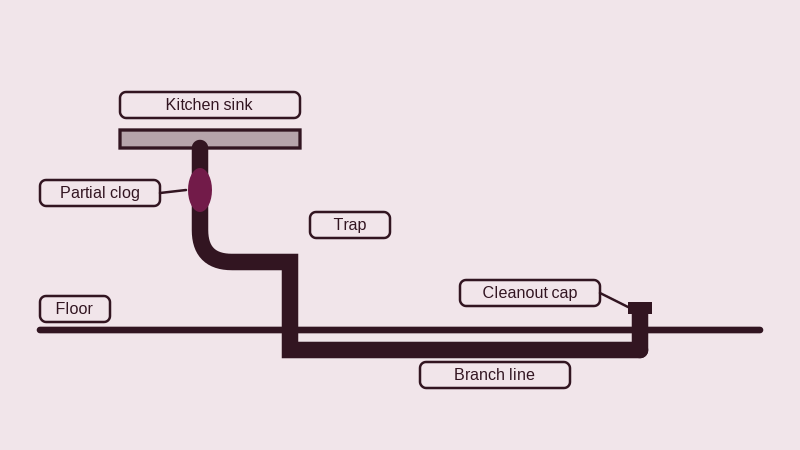
Slow drainage means something is narrowing the pipe: hair and soap in bathrooms, grease and food scraps in kitchens, or a partial blockage deeper along the line. Water that pools and then creeps away points to a partial clog, not a full one. Dealing with it early prevents a complete backup. For a deeper blockage, see clearing drains and clogs.
Why is a kitchen sink slow to drain?
Grease causes most kitchen slowdowns. Hot cooking fat flows down the drain, cools, and coats the pipe wall, and food bits stick to it until the opening shrinks to a fraction of its size. Coffee grounds, rice, pasta and eggshells add to the layer. A double kitchen sink adds a twist, since both basins share a trap and a branch, and the problem can sit past the join.
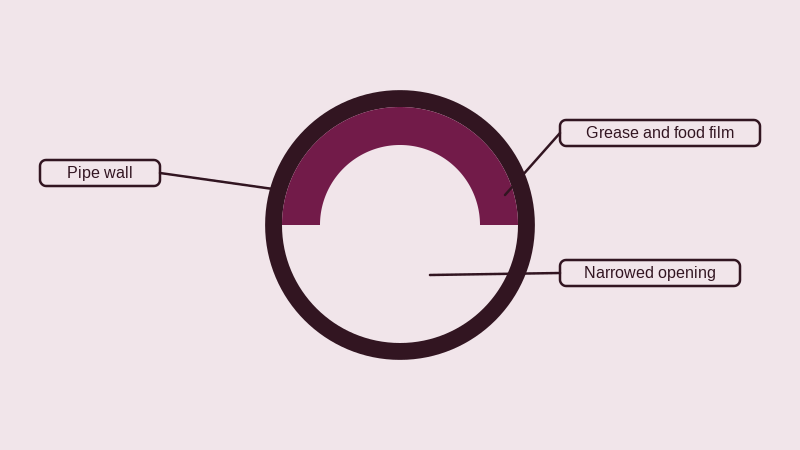
If only one basin is slow, the clog is probably in that basin's tailpiece or trap. If both are slow, the restriction is past the join or in the wall line. A kitchen sink that is slow but not fully blocked is often at the early stage of that grease build up. A garbage disposal can also hide a partial jam, which is why the garbage disposal repair page matters if your drain feeds one.
Dishwashers drain into the same line, so a slow sink with a dishwasher that leaves standing water points to the line past the dishwasher connection.
What slows down a bathroom sink?
Hair, toothpaste, soap scum and shaving residue knit into a sticky mat right under the stopper, in the top few inches of pipe. Most bathroom clogs sit in the pop-up stopper assembly or the trap, which is why they are the easiest to fix by hand. Mineral buildup in hard-water areas can add a coating that slows things further.
A bathroom sink that is slow but not clogged is often caused by the stopper itself. The pivot rod and the stopper catch hair, and the stopper only opens partway. Pull it out, wipe it, and clear the strands, and the flow often returns. Two step-by-step guides, on fixing a slow bathroom sink drain and clearing a bathroom sink clog, cover it.
What should come before a chemical drain cleaner?
Begin with the simplest tools. Take out the stopper or strainer and clear whatever shows. Flush with very hot water, but not boiling if the pipe is PVC. A cup plunger works on a sink if you plug the overflow opening with a wet rag, which sends the force down the pipe. Put a bucket beneath the trap, unscrew it and clean it out.
Baking soda and vinegar will not break a hard clog, though it can loosen light film. A manual drain snake or a plastic hair-catching strip reaches further than a plunger. Avoid mixing different chemical cleaners, since combining them can release harmful fumes, and wear gloves and eye protection. Most liquid drain cleaners also damage old pipes and can splash onto skin. Read the product label and never use a chemical cleaner before a plumber snakes the line, because the plumber may then be handling caustic water.
Use this order:
- Clear the stopper or strainer by hand.
- Plunge with the overflow blocked.
- Remove the trap under the sink and tip its contents into a pail.
- Use a small hand snake.
- If the water still crawls away, stop and ask for help.
When is a slow drain a bigger problem than the sink?
If several fixtures drain slowly at once, such as the sink, the shower and the toilet, or if gurgling sounds appear when a washer drains, the blockage likely sits in the main line instead of at the sink. A toilet that bubbles water up into a tub is another warning of a main line backup. More on this is in the how to unclog a drain guide.
Older homes in Casa Conejo and Wildwood may have older drain lines, and roots can enter clay or cast iron lines in mature neighborhoods with large trees. In older Thousand Oaks and Newbury Park homes, a long drain run with a small dip can hold debris. Whole-house slowness belongs with a plumber who can run a camera down the line.
What to do next
If the manual fixes fail or the whole house is slow, send in a request so that a local plumbing business can give a drain cleaning quote. Mention which fixtures are slow, the length of time the problem has lasted, whatever you have poured down the drain, and whether any other drain gurgles. Photos of the trap and surroundings help. The plumber may bring a motorized snake or a camera, and the guide to what unclogging a sink costs explains what changes the price.
Do not ignore it. A drain only slightly slow now can clog fully at the worst moment, such as a family event, and a backup into a cabinet can damage the wood. Water around the cabinet base may also signal a leak: the EPA estimates that more than 9,300 gallons of water a year are wasted through household leaks, so check the supply lines too.
Common questions
How much time does a slow sink repair take?
Clearing a plain clog at the trap usually makes for a quick visit. A deeper line that needs a motorized snake or a camera takes longer, and the plumber can say how much once the trap and line have been looked at. A main line problem means extra time and may need a second visit.
What should I ask before hiring someone for drain cleaning?
Ask what the visit includes, whether a camera inspection costs extra, how pricing works (flat or hourly), who is responsible for a cracked pipe, and whether the findings will be explained. Get the contractor license number and check it. A good answer names the tool and the likely cause, not just a price.
Do I need to stay home during drain cleaning?
Mostly yes, at least at first, so the plumber can look at the sink and hear what you noticed. Clear out the cabinet under the sink beforehand, since the plumber needs room. For main line work or an outdoor cleanout, an adult should still be reachable to approve extra work before it starts.
Is it okay to pour salt or baking soda down a drain?
Salt and baking soda will not clear a real clog, and neither one is a substitute for removing the debris. A baking soda and vinegar flush can loosen a light film, then rinse with hot water. Anything more serious needs a plunger, a snake or a plumber, and a chemical cleaner makes later work more hazardous.