Almost every drip from a tub faucet traces to one worn internal part: a rubber washer, an O-ring, a seat or a cartridge. You shut off the supply, take the handle apart, pull out the tired piece and install an identical one. Plenty of people get it done in a single short sitting. If the valve body has corroded, or the water is escaping inside the wall, a plumber is the better call. Look through the faucets, sinks, showers and disposals hub for more, or request a visit.
Where is the water coming from?
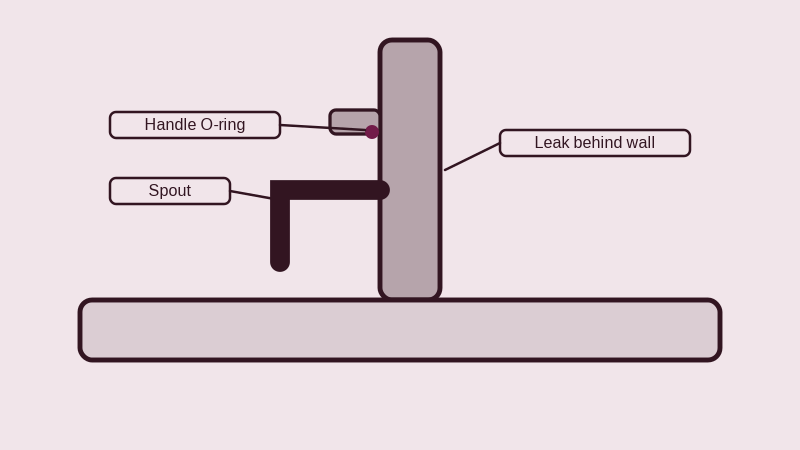
Start by noting exactly where the moisture appears, since each location points to a different repair. A spout that drips after the tap is shut off has a valve that no longer seals. Wetness at the base of the handle suggests a tired O-ring or packing. If water shows up inside the wall, or a stain spreads across the ceiling beneath the bathroom, the leak is out of reach from the front.
Use this guide:
| Where the water shows | Likely cause | Fix |
|---|---|---|
| Drip at the spout, handles closed | Tired washer, seat or cartridge | Replace the worn internal part |
| Leaks around the handle | Worn O-ring or packing | Replace the O-ring or the packing nut |
| Flow from the spout when the diverter is lifted | Failed diverter | Replace the diverter |
| Wall or ceiling stain | Leak behind the wall | Plumber |
| Drips from the shower head after use | Worn valve cartridge | Replace the cartridge |
Even a slow drip loses more water than you would guess, and a hot drip burns energy too. Fix it soon. Our companion guide on a leaking bathtub faucet tackles the same job from the tub side.
How can you identify the faucet type?
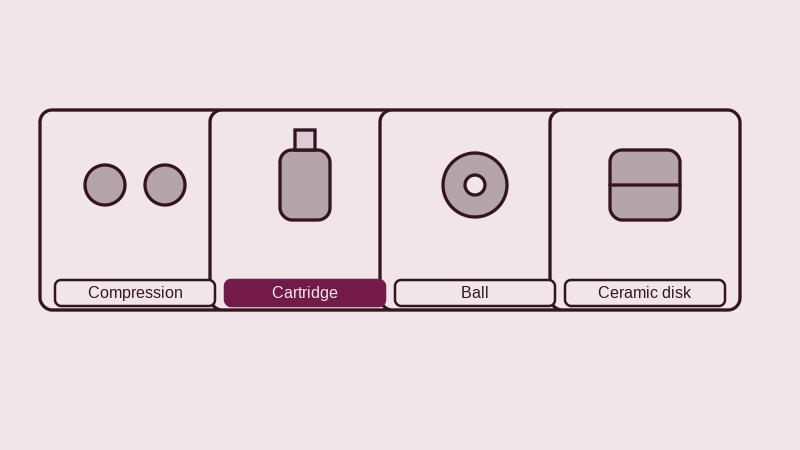
Four types are common. Compression faucets have two handles, one hot and one cold, that turn through several rotations; cartridge faucets have a stem that pulls straight out; ball faucets appear in certain single-handle designs; ceramic disk faucets are found in newer single-handle models. The handle style and count give strong hints, and removing the handle reveals the rest.
Clues:
- Two handles that spin round and round: probably compression, with a rubber washer on a stem.
- One handle that moves up and down and swings left to right: cartridge, ball or ceramic disk.
- A brand name on the handle or escutcheon: look up the model number to find the exact cartridge.
- A short quarter-turn handle: often ceramic disk.
Shower valve cartridges differ by brand, so carry the old one with you when shopping. Our guide to a leaky Delta shower faucet covers one popular brand in detail.
What are the repair steps?
Shut the bathroom's stop valve, or the main if the room has none, and open the faucet to drain what remains. Then take off the handle, the trim and the stem or cartridge. Replace whichever of the washer, O-ring or cartridge has worn out with an exact match, reassemble in reverse order, and bring the water back slowly while you test.
Step by step:
- Close the water supply. Block the tub drain so small screws cannot fall down it.
- Lever the decorative cap off to reach the handle screw, back the screw out, and slide the handle free.
- Unscrew the trim plate, then remove the clip or nut holding the stem in place.
- With a compression faucet, back the stem out and fit a new rubber washer and O-ring in place of the old ones. Inspect the brass seat in the valve body. A pitted seat can be refinished with a seat dresser or seat wrench.
- On a cartridge model, draw it straight out, often with a puller tool, and set the new cartridge in with the same orientation.
- Smear plumber's grease lightly over the O-rings, put the parts back together and reopen the supply gradually.
- Test hot and cold, and watch for drips over the next day.
Do not force anything. A stuck cartridge is a common point where an owner breaks something. If it will not come, stop and ask for help.
Why does the drip continue after a new part?
A lingering drip can mean a worn or pitted valve seat, a replacement of the wrong size, or a cartridge fitted backwards. In a compression valve, a damaged seat keeps leaking whatever washer you fit. Re-check the part number, reseat the cartridge, and consider a seat repair or a new valve body.
Hard water can make this worse by crusting the seat with scale. Soak the parts in vinegar and clean the seat. Scale damage that keeps returning is covered in preventing hard water scale, which sets out the options. A faucet in a house with very high water pressure also wears quickly, so ask a plumber to measure the pressure if you keep replacing parts. See water pressure regulator replacement.
At what point should you hand it to a plumber?
Bring in a plumber if the shutoff refuses to close, if the stem or cartridge has seized, if corrosion has taken over the valve body, if the leak is hidden in the wall, or if tile keeps you from the valve. Also stop when restoring the water leaves you unsure. Cutting into a wall for valve access is work for a plumber and a tiler.
Local housing adds a few more reasons. Tract homes built in Thousand Oaks and Newbury Park between the 1960s and the 1990s can still have original valves and no local shutoff, so the entire house must be turned off for the repair. Valves that old may also be worn enough that a fresh cartridge will not seal. If the valve has to be replaced, the plumber normally works from behind the wall, often via a neighboring closet or an access panel.
Permits are not normally needed for a faucet repair, but replacing a valve inside a wall may be treated differently. Ask City of Thousand Oaks Building and Safety, or the Ventura County Resource Management Agency for unincorporated addresses.
What tools and parts should I gather first?
Gather a flat screwdriver, a Phillips screwdriver, an adjustable wrench, a hex key set, pliers, plumber's grease, a cartridge puller if your brand uses one, vinegar, a rag, a flashlight and replacement parts. Bring the worn part along when buying a match. Spread a towel across the tub floor to guard the surface and catch dropped parts.
Put small parts in a cup so nothing is lost. Photograph each step so that reassembly is simple. Mark the orientation of the cartridge with a pencil, since many cartridges have hot and cold sides.
The same steps apply to the vanity tap, covered in fixing a leaky bathroom faucet.
Common questions
How much time should a tub faucet repair take?
A simple washer or cartridge change typically fits in a short session. Add time if the shutoff is stiff, parts are stuck, or you need a trip to the store. A plumber is usually quicker, having parts on hand. If a valve has to be replaced behind a wall, plan on a longer job.
Do I need to turn off water for the entire house?
Only when the bathroom lacks local shutoff valves. Many older homes have none, so the main must be closed. Open a lower tap to empty the line and ease pressure. Fit shutoff valves for the future if possible, since they simplify the next repair. A plumber can add them in a short visit.
What makes a tub faucet leak on the hot side only?
A worn hot-side cartridge or washer is the usual cause, since heat can soften or swell the parts. Mineral buildup on the seat can do it too. Replace the hot-side part and clean the seat. If both handles share a single cartridge, that cartridge is the culprit.
Can a leaking tub faucet cause water damage?
Yes, if it leaks inside the wall or around the escutcheon, it can soak drywall and framing over time. A constant drip from the spout is mostly a waste of water. Check the ceiling below and the wall around the faucet for stains. Our guide to knowing if a pipe has burst lists other warning signs.
How can I arrange a plumber visit?
Send the price request form with your faucet brand, the spot where it leaks and whether the bathroom has shutoff valves. We pass your request to a local plumbing business, and a plumber from it visits and writes up a quote. Local plumbing businesses that accept requests pay us a fee. For the other jobs we arrange, see Conejo Plumbing Pros.